
BEAT: 21st Century Crimson Men (Part 3 of 3)
Continued from Part Two…
Speaking of surprises, what, if anything, has surprised or impressed you the most about putting this project together?
There was one thing that really surprised me. I didn’t know Steve Vai; I had met him once or twice in passing over a few decades. Here’s a guy I never knew; he’s a giant guitar god, and he could be anything he wanted to be. He could be a real jerk if he wanted to be.
But he’s a very hard working guy, and his attitude is perfect. I’m thoroughly, happily surprised with the way he is as a person and as a player. He’s so highly professional and down to earth. There’s not a drama there; there’s no ego thing going on. It’s not all about him. It’s really, “I want to be in this. I want to be a team player.”
The other thing is our producer, Scrote. He decided, “If we’re going to take this on, we really have to have the right kind of company to do this.” So he formed a production company with Miles Copeland, who managed the Police and managed to change the world. He has a history of being great at a lot of things, and he hand-picked the right crew to do this properly. So, for me, BEAT is actually on a higher level in lots of ways; not just the quality of musicianship and the material. I especially love being in something that doesn’t have any obvious problems written all over it. This is a good team.
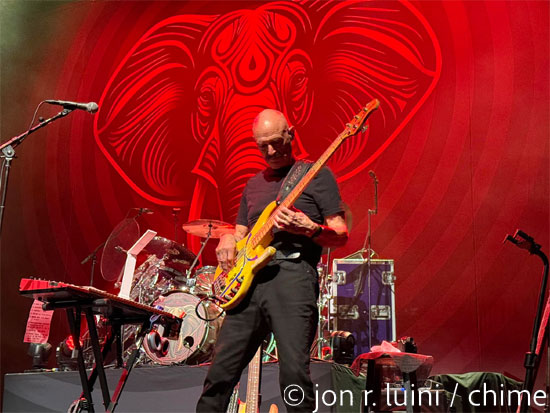
Back in the ‘80s when Discipline became King Crimson, was the idea to wipe the slate clean and sound completely different than previous lineups?
That was absolutely the goal from the beginning. And that’s probably why Robert [initially] didn’t want to call it King Crimson; he didn’t want any association; he had a very strong vision of what he wanted it to be. And we said, “We’ll follow your vision on this, and happily do that.”
But Tony and I had complained more than once about the name Discipline. We said, “We don’t really love that name. Maybe it has a different connotation for you, but being Americans, for us it’s kind of an unfriendly name. Can we name it something else?”
It was a few weeks into rehearsing when the material was starting to flow, and Robert came in and said, “Whatever we call this band, it has the spirit of King Crimson.” And I said, “Well, then, why don’t we call it King Crimson?” To me personally, I respected that band second only to the Beatles. And I thought, “This is a higher level of music, and I would be proud to be in a band called King Crimson.”
I really take great pride in King Crimson. It meant a lot to me, and it drew a different line in the sand for me personally as to what I could and couldn’t do, how I had to behave and what I could and should write. At the same time, I was starting to put out my solo record. So anything that seemed not right for King Crimson, I had another perfect place to put it.
When I first heard the Discipline LP, I remember thinking that there was really no precedent for what King Crimson was doing. Did you have a sense at the time that the four of you were really blazing new paths?
I thought there was nothing at all like it. For one thing, every one of us had new technologies at our fingertips that no one else had used. Both Robert and I had guitar synthesizers. Bill was the first person silly enough to try to make electronic drums work. And then Tony Levin walked in with this thing called the Chapman stick, something you’d never even seen before.
So I knew the musical language of what we were doing was going to be different, no matter what. And it was a time period when there was a lot of freedom and creativity. At least in our line of the music business, but maybe not in the mainstream. But it was a time when you really felt like you could do those kinds of things, and King Crimson were definitely the people to do it.
Someone told me once, “You guys have a license to kill.” And I think that’s true, because we could do whatever we wanted. We weren’t trying to be the next big thing; we weren’t trying to write hit songs or be on the radio or anything. We were just trying to create something no one had ever heard.
When these concert dates for BEAT were announced, tickets for many of the shows sold out almost immediately. Did that surprise you?
It did. The team putting all this together was saying, “We want to go in small; we don’t want to try to play bigger places. We’d rather play a smaller place and pack it out.” Normally, that would have been my philosophy, too, but we were feeling like, “Wait a minute. I think you’re going to find out there’s a lot of pent-up desire to see this. It’s not been done for decades.” My wife, who manages me, would say, “This is going to be more than you think. If you don’t know the history of Crimson and the fan base and things like that, you’ve got to take that more in consideration.”
You have people who did get to see some of it back then, but mostly you have a brand new audience, and then on top of that, you have the Tool [fans] coming; that’s a huge audience. And then you have Steve Vai’s audience. So I felt like, “There’s no way this is going to lose.”
But it was still surprising that it happened. The explosion part of it, I wasn’t ready for. I thought it would be a slow buildup and gradually everything would present itself. We [originally] thought we’d do 30 or 40 shows. We’re now doing 65 and we’re covering a whole lot of area.
BEAT strikes me as an opportunity for that music to get some of the recognition that it didn’t get the first time around…
Absolutely. And that’s another reason to do it. That’s another thing I thought: “That music, those records deserve a second chance. They are pretty timeless. They sound brand new. They sound fresh.” There’s still nothing like it.
About the Author

Bill Kopp
With a background in marketing and advertising, Bill Kopp got his professional start writing for Trouser Press. After a stint as Editor-in-chief for a national music magazine, Bill launched Musoscribe in 2009, and has published new content every business day since then (and every single day for several years). The more than 5000 interviews, essays, and reviews on Musoscribe reflect Bill's keen interest in American musical forms, most notably rock, jazz, and soul. His work features a special emphasis on reissues and vinyl. Bill's work also appears in many other outlets both online and in print. He regularly hosts lecture/discussions on artists and albums of historical importance (including monthly events Music to Your Ears and Music Movie Mondays), and is a frequent guest on music-focused radio programs and podcasts. In Spring 2023 he taught a history of Rock 'n' Roll at UNC Asheville's College for Seniors. He also researches and authors liner notes for album reissues -- some 40 to date -- and co-produced a reissue of jazz legend Julian "Cannonball" Adderley's final album. His first book, Reinventing Pink Floyd: From Syd Barrett to The Dark Side of the Moon was published by Rowman & Littlefield in 2018, and in paperback in 2019. His second book, Disturbing the Peace: 415 Records and the Rise of New Wave, was published in 2021 by HoZac Books. His third book, What's the Big Idea: 30 Great Concept Albums is available now. Read even more about him here.