
BEAT: 21st Century Crimson Men (Part 1 of 3)
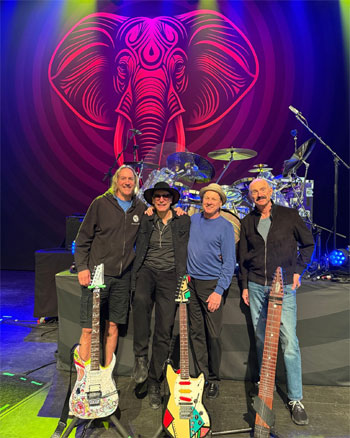 Formed in 1969 in London, King Crimson was at the vanguard of progressive rock. Led by innovative guitarist Robert Fripp, the band made some of the most boundary-pushing, uncompromising music ever heard. But in the group’s original run (1969-1974) King Crimson went through myriad changes; though they released eight albums, no lineup stayed together long enough to make a second record.
That changed when the group resumed operation in 1981. A quartet featuring two British musicians (Fripp and former Yes drummer Bill Bruford) and two Americans (guitarist Adrian Belew and Chapman stick player Tony Levin) debuted a different, even more forward-looking sound. This new Crim drew inspiration from industrial and so-called world music, with a strong improvisational approach that connected it to earlier lineups. The ‘80s King Crimson would make three acclaimed albums before it, too, went inactive.
King Crimson would return for two more extended runs, finally going out on a high note and calling it a day in 2021. But the appeal of the 1980s lineup has long held a special place in the hearts and minds of listeners. And those fans were given a true gift when the formation of BEAT was announced: a new quartet featuring two members of the ‘80s King Crimson lineup would be joined by two more world-class virtuoso players: guitar wizard Steve Vai and Tool drummer Danny Carey.
BEAT just concluded a 60-plus date North American tour, bringing the game-changing music of 1980s King Crimson to 21st century concert audiences. Ahead of the tour, I spoke with guitarist, singer, songwriter and project leader Adrian Belew.
Tell me about the inspiration behind launching this BEAT project.
It’s been a five-year process to get to this point. It came about in 2019, when I realized that 2021 would be the 40th anniversary of the 1981-to-’84 quartet [lineup of King Crimson]. And I thought, “We should do something, even if it’s just a few major cities.” I called Robert Fripp, of course. He already had a lot of things planned and said that there was no way possible he could do it. But he also said, “If it’s important to you and you want to drive it” – that’s the term he used – “then I think you should go ahead and do it.” I called Bill Bruford as well, but I knew already that he wouldn’t be able to do it. He hasn’t played for a long time and has made a decision to stay retired.
So what happened next… I was working with the producer from the Celebrating David Bowie shows, and we started brainstorming about how maybe to do it ourselves, somehow. And I remembered that years ago I had read an interview with Steve Vai, where he said how much that ‘80s King Crimson music meant to him; that it was something that he thought was great, especially Robert’s technique of playing. So I said, “I don’t know Steve Vai, but I’m gonna call him.” And I did. And his response was incredible; he was very excited about the idea. I found out later that he’s at a point in his life where he feels like he really needs a challenge, and this was it. So it was perfectly timed. And then we continued to think about bass players and drummers.
And then Covid hit. Two and a half years later, when people were finally out and playing concerts again, I called Steve Vai again, and he said he was more excited than ever. But previous to Covid, he had 18 months of touring planned, and now he had to fulfill those obligations. So that meant another year and a half. At that point, I said, “Well, what the heck? Tony Levin is now touring with Peter Gabriel. Why don’t we wait until that’s over and see if he wants to be the bassist? Because that would really bring the band to a whole new level, of legitimacy and otherwise. And that happened.
I’d always wanted Danny Carey, but he was engaged with Tool. [The members of] Tool are friends of ours, and friends to my wife and our little darling children. I went to a Tool show in Nashville and told Danny about this project, and he was just over the moon about it. He said, “The tour is almost ending. Let me talk to [the other guys in] Tool, and I’ll call you back in three days.” And three days later – the longest three days of my life! – he did call. And he said, “We’re good to go.” He was very excited. In fact, Tool’s manager Al Jones says that Danny is walking around with a perpetual grin on his face.
And that’s how it came about.
Didn’t the King Crimson “double trio” tour with Tool at one point?
Yes, we did. They were kind enough to ask us to come out and be their opener because they wanted to introduce their audience to the people who influenced them. So it was a very amazing gesture.
About the Author

Bill Kopp
With a background in marketing and advertising, Bill Kopp got his professional start writing for Trouser Press. After a stint as Editor-in-chief for a national music magazine, Bill launched Musoscribe in 2009, and has published new content every business day since then (and every single day for several years). The more than 5000 interviews, essays, and reviews on Musoscribe reflect Bill's keen interest in American musical forms, most notably rock, jazz, and soul. His work features a special emphasis on reissues and vinyl. Bill's work also appears in many other outlets both online and in print. He regularly hosts lecture/discussions on artists and albums of historical importance (including monthly events Music to Your Ears and Music Movie Mondays), and is a frequent guest on music-focused radio programs and podcasts. In Spring 2023 he taught a history of Rock 'n' Roll at UNC Asheville's College for Seniors. He also researches and authors liner notes for album reissues -- some 40 to date -- and co-produced a reissue of jazz legend Julian "Cannonball" Adderley's final album. His first book, Reinventing Pink Floyd: From Syd Barrett to The Dark Side of the Moon was published by Rowman & Littlefield in 2018, and in paperback in 2019. His second book, Disturbing the Peace: 415 Records and the Rise of New Wave, was published in 2021 by HoZac Books. His third book, What's the Big Idea: 30 Great Concept Albums is available now. Read even more about him here.