
System 7’s Second Summer of Love (Part 1 of 3)
A shorter edit of this feature was first published on The Tonearm.
Steve Hillage and Miquette Giraudy embarked on their fascinating musical journey several decades ago. They began working together musically within the context of Canterbury-meets-French-freaks collective Gong, continuing on to record and touring in support of Hillage’s albums. Along the way, they’ve explored psychedelia, ambient and other forms. Their musical odyssey eventually led them to the world of techno and dance music. Concurrent with other projects, they launched System 7 in the late 1980s.
In 2026 System 7 released Flower of Life, their 15th studio album. While it’s stylistically consistent with previous releases, the new album may be the project’s most successful synthesis to date in terms of blending and balancing Hillage’s lyrical, melodic guitar work with the heady beats and textures of electronica. I spoke with Steve and Miquette via video chat about System 7’s beginnings; the allure that dance music holds for them; the ways in which the duo constantly reinvents, revises and re-processes existing material; and the joy they derive from collaborating – together and with other innovative artists.
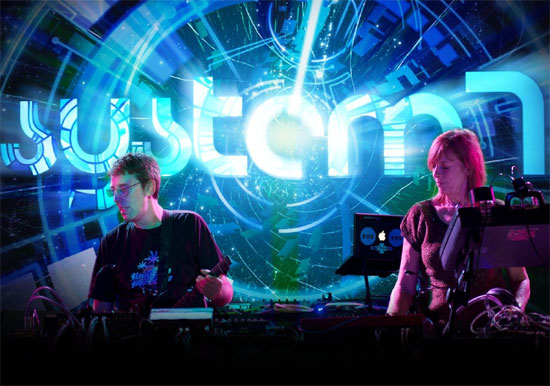
Bill Kopp: First, let’s go way back. What inspired you to bring System 7 into being?
Steve Hillage: Oh, it’s quite a long story. We were quite involved in electronic music back in the ‘70s. And that’s one of the reasons why we wanted to work with Malcolm Cecil, who produced our [1977] Motivation Radio album, because we loved his Tonto’s Expanding Headband. We had quite a lot of contacts with German groups from that time. And in German psychedelia in particular, with a chap called Manuel Göttsching of Ash Ra Tempel. Our good friend, the late great Manuel Göttsching is someone we sorely miss.
And then in the ‘80s I was very much focusing on record producing other artists, and there was a whole stirring in dance music. At the beginning of the ‘80s, in fact, I was working with Simple Minds doing club remixes, and there was a whole club scene then called Futurism. The whole thing just blew up in the ‘80s, and we felt this irrepressible urge to become part of the new dance music movement. That’s also when we met Alex Patterson of the Orb. It was what they called the Second Summer of Love, which appealed to our idealism.
And we’ve been doing it now for almost 40 years.
We still like playing the older stuff in the rock band format as well. We’re doing a festival in Italy in July where Miquette and I are performing a [1979] Rainbow Dome Musick set; we’ve worked out a way of doing it live. Also, I’m guesting with the current lineup of Gong, and we’re going to play a Gong set together. I still love doing all that, but System 7 is our main thing.
Bill: Would you say that System 7 brings together the psychedelic creative and musical values from Gong with the qualities of acid house?
Steve: Absolutely. When we first started System 7, we thought it’d be really cool to make really groovy dance tracks with some of our old classic psychedelic sounds on top; that was the original idea. We thought we could carve out a special identity in the dance music world, and it seems to have worked.
Bill: How do you think that the appearance of System 7 made an impression on the character and subsequent direction of the electronica underground in the UK?
Steve: We were one of the first techno groups to play live. We actually had live instruments going, and were still making incredible techno and tech house sounds, so we’ve had quite a big influence on the live scene. And right now there are a lot of live techno that includes instruments: I saw a Japanese [band] with a trumpet! We’ve become more fashionable in a way, because we’ve been putting live instruments on [the music] for a long time.
And we’ve also had a lot of contacts through various collaborators who we’ve worked with, and people who wanted to work with us. We’ve got a little spot on the dance music map, and I do think we’ve had an influence, but we accept – and hunger for – influence [upon] ourselves. That’s for sure as well.
Bill: The presence of real instruments definitely adds a dynamic element to the live experience. I have seen some performances where it’s basically two dudes and two laptops. And while it sounds great and feels great, it’s not too exciting to look at. Because for all you know, they’re up there just reading the news.
Steve: You know, I have to confess: we’ve got two laptops on stage. But we’ve got other stuff! And I’ve got a radio mic on my guitar so I can wander about while I’m playing; I’m not just rooted to my spot.
Bill: Miquette, I know that you were involved on both sides of the camera in the film world; you were an assistant editor on the Barbet Schroeder film More…
Miquette: Correct. I was doing the continuity on More.
Bill: From your involvement in film, what did you learn about the effective use of music in multimedia?
Miquette: I don’t know, because I just go on feeling. I’m not an intellectual. I [studied] images from a very young age; and I had my photo lab at 15. And then later in life I started loving the sound scene and becoming [involved with] that. But in movies, I was working in the Service de la Recherche and I did all kind of things which influenced me without me knowing it, if you see what I mean.
Steve: I will interject that M. did a really amazing, quite celebrated interview with [Karlheinz] Stockhausen.
Miquette: The Recherche in France was involved with all those really wild musicians, you know. I was in the movie side of it, not the sound. But the sound was just impregnating me without me knowing it.
Steve: [to Miquette] Well, you eventually jumped ship. You jumped ship when you got involved with Gong.
They came to do the music for one of her movies. She got enamored with them as a band and as a concept, so she ended up becoming part of the Gong family.
Miquette: I was doing some sound on a movie by a painter called Martial Raysse [1972’s Le grand départ]. And they arrived in my editing room and I was completely “What are those bunch of zombies there?” And I was like, “Wow, this exists?” Then I joined them after that.
To be continued…
About the Author

Bill Kopp
With a background in marketing and advertising, Bill Kopp got his professional start writing for Trouser Press. After a stint as Editor-in-chief for a national music magazine, Bill launched Musoscribe in 2009, and has published new content every business day since then (and every single day for several years). The more than 5000 interviews, essays, and reviews on Musoscribe reflect Bill's keen interest in American musical forms, most notably rock, jazz, and soul. His work features a special emphasis on reissues and vinyl. Bill's work also appears in many other outlets both online and in print. He regularly hosts lecture/discussions on artists and albums of historical importance (including monthly events Music to Your Ears and Music Movie Mondays), and is a frequent guest on music-focused radio programs and podcasts. In Spring 2023 he taught a history of Rock 'n' Roll at UNC Asheville's College for Seniors. He also researches and authors liner notes for album reissues -- some 40 to date -- and co-produced a reissue of jazz legend Julian "Cannonball" Adderley's final album. His first book, Reinventing Pink Floyd: From Syd Barrett to The Dark Side of the Moon was published by Rowman & Littlefield in 2018, and in paperback in 2019. His second book, Disturbing the Peace: 415 Records and the Rise of New Wave, was published in 2021 by HoZac Books. His third book, What's the Big Idea: 30 Great Concept Albums is available now. Read even more about him here.