
Album Review: Bob Mosley – Bob Mosley
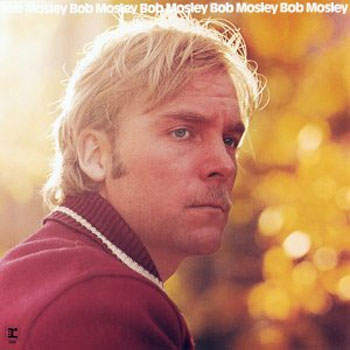 The saga of Moby Grape is one of the saddest in rock history. Possessed of stunning levels of creativity and talent, the San Francisco group fell victim to a poisonous combination of bad judgment and ill-intentioned management. They turned out a near-perfect debut album and then flamed out, creating a succession of flawed releases that – while well worth hearing – only hinted at the heights scaled by that debut. Guitarist Skip Spence was the first to burn out, and his story is comparatively well-known. But Moby Grape was stuffed to the gills with talented members – all could write, sing lead, etc. – and bassist Bob Mosley wrote and sang some fine tunes that would become Moby Grape classics.
Mosley’s story was in its own way more complicated than Spence’s. With the benefit of hindsight it’s clear now that he suffered from schizophrenia at a time when the condition was less understood than it is now, and less effectively treated. So it was that when the band was still a going concern, somehow Mosley quit the group and enlisted in the U.S. Marines. Yes, during the Vietnam era, he signed up willingly. The USMC showed him the door within months. In subsequent years he vacillated between participation in various attempts to reboot Moby Grape and extended bouts of homelessness.
Remarkably, even against that backdrop, Mosley has crafted no less than six solo albums. His first, the self-titled release for Reprise Records, has been out of print for ages. Save for a dodgy 2005 reissue on CD by Wounded Bird (a label known for sourcing reissues from needle drops), the only available versions of Bob Mosley were those issued on vinyl or 8-Track in 1972.
That has changed. Among other things, NYC-based Omad Records (run by hit songwriter John Denicola) has been responsible for releases from Peter Lewis, one of Mosley’s old Moby Grape band mates. It’s a small label, with only a couple dozen releases to its credit, but Omad has seen to a release of the long-unavailable debut album from Mosley.
Moreover, Omad hasn’t simply reissued the album. Using DeMix technology, they’ve arguably created a superior mix of the record, one that brings Mosley’s vocals and bass to the fore in a way that the original did not. (For some quick background on the AI-based DeMix technology, I’d refer you to my interview with Blue Öyster Cult members Buck Dharma and Eric Bloom, and to an essay I wrote about a recently-unearthed live Beatles tape. The technology is amazing stuff, and it works: myself, I’ve fiddled with the open-source version.)
Listeners expecting a singer-songwriter affair are in for a rude awakening. The album opens with the propulsive and rocking “The Joker.” Mosley wails on vocals in the manner of a blues shouter, and the band pummels along with alacrity. Well-placed lead guitar fills add even more energy. Outside of “Fall On You,” Moby Grape rarely rocked as hard. And thanks to the re-de-mix, Mosley’s powerful bass work shines.
“Gypsy Wedding” found its way into later-period Moby Grape live sets, and with good reason. The funky tune with tasty electric piano and punchy support from the Memphis Horns is a highlight of the record; it sounds like the kind of song that would have figured prominently in free-form FM radio programming of the era. The possibly autobiographical “1245 Kearny” is a stomper as well, with judicious use of wah-wah and another spirited Mosley vocal. “Squaw Valley Nils (Hocked Soul)” serves up some strong vocal harmonies (overdubbed Mosley himself, sounds like) atop a solid melody.
The horns return for “Let the Music Play,” yet another strong rocker. The arrangement gives prominence to the horn charts and fuzzed-out rhythm guitar, and (again) the new mix affords Mosley’s driving bass the prominence it deserves. Those horns spar with the lead guitar during the quick break, which is nearly too much, but ultimately not too much. Mosley turns down the intensity for the countrified “Thanks,” originally the closing cut on Side One. Some lovely vocal harmonies and keening pedal steel are among the tune’s virtues.
“Where Do the Birds Go” rocks in a Grand Funk manner. “Hand in Hand” doubles down on Mosley’s use of multi-tracking his powerful voice. The shuffling tune has a bit of a Doobie Brothers character, but adding a wild, Bay Area psych guitar feel redolent of Quicksilver Messenger Service. “Hand in Hand” would have been a powerful live number. “Gone Fishin’” has a very different feel, with Mosley taking more relaxed, down-home vocal tone; the melody is as close to mainstream pop as he’d get on this record.
The Memphis Horns open “Nothing to Do,” another speedy number; it’s the album’s best application of the Memphis/Stax feel to Mosley’s own aesthetic. With a mid-song rhythm changeup, it also sounds the most like a Moby Grape tune. The record closes with “So Many Troubles,” giving Mosley an opportunity to apply his considerable vocal talents in a ballad format. The melancholy track has a subtle gospel flavor.
In a fair world, Bob Mosley wold have been a major hit. Its weakest tracks are never less than good, and its best cuts rival the finest Moby Grape classics. After years out of print, the reappearance of Bob Mosley rights a serious wrong. And word is that Mosley himself is doing well these days, and will rightly benefit from sales of his reissued debut album.
About the Author

Bill Kopp
With a background in marketing and advertising, Bill Kopp got his professional start writing for Trouser Press. After a stint as Editor-in-chief for a national music magazine, Bill launched Musoscribe in 2009, and has published new content every business day since then (and every single day for several years). The more than 5000 interviews, essays, and reviews on Musoscribe reflect Bill's keen interest in American musical forms, most notably rock, jazz, and soul. His work features a special emphasis on reissues and vinyl. Bill's work also appears in many other outlets both online and in print. He regularly hosts lecture/discussions on artists and albums of historical importance (including monthly events Music to Your Ears and Music Movie Mondays), and is a frequent guest on music-focused radio programs and podcasts. In Spring 2023 he taught a history of Rock 'n' Roll at UNC Asheville's College for Seniors. He also researches and authors liner notes for album reissues -- some 40 to date -- and co-produced a reissue of jazz legend Julian "Cannonball" Adderley's final album. His first book, Reinventing Pink Floyd: From Syd Barrett to The Dark Side of the Moon was published by Rowman & Littlefield in 2018, and in paperback in 2019. His second book, Disturbing the Peace: 415 Records and the Rise of New Wave, was published in 2021 by HoZac Books. His third book, What's the Big Idea: 30 Great Concept Albums is available now. Read even more about him here.