
Edge of the World: Let’s Active at 40 (Part 2 of 3)
 Continued from Part One…
Easter looks back at that period – now thought of as the dawn of “college rock” or alternative rock – as a musically freewheeling time when the possibilities were open-ended. “If your band seemed to fit with what the audience was looking for, you could kind of get away with murder in some ways,” he says. “Because the times were changing.”
To the members of Let’s Active, that first gig at 688 represented a turning point. Not just for them, but as part of something bigger. “Around here,” says Easter, referring to the Winston-Salem bar and music scene, “things were just barely coming out out of the dark ages of beer drinking and getting sick.” He notes that bars were generally depressing places, even if they had music (and many did not). But the tiny Atlanta club on Spring Street “seemed to have a cultural stance about it,” Easter says. Headlining act R.E.M. was “instantly beloved” by the crowd at 688.
And that affection extended to the unknown trio from North Carolina as well. “There were a lot of people there,” Easter recalls. “And they kind of paid attention to us. They couldn’t have known who we were, but they looked at us and clapped.”
With their spare, unconventional sound and Easter’s appealing (but decidedly un-rock-god-like) vocals, Let’s Active benefited from the openness of the emerging music scene. Easter observes one of that scene’s defining characteristics. “When people focus on what they are, they also sometimes really focus on what they are not,” he says. “And that scene was definitely defined by what it was not: ‘It’s not what’s on the radio, and it’s not classic rock, and it’s not stadium rock,’ you know?”
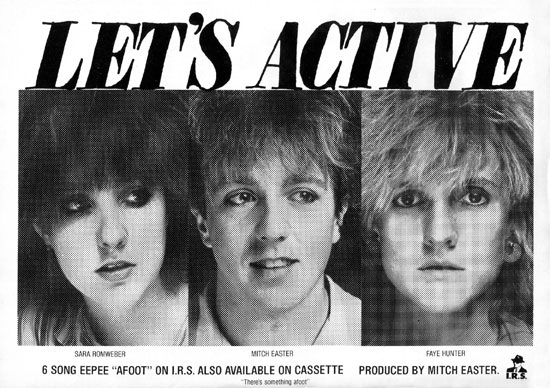
Easter returns to his point about Let’s Active not being a logical extension of his earlier bands. “If I had played with my old buddies in the band,” he suggests with a hearty laugh, “we would’ve looked like we were going to bust into an Allman Brothers song!” And while he doesn’t want to over-emphasize the visual aspect of his new trio, Easter acknowledges that it was significant. Sara Romweber and Faye Hunter “just didn’t look like most of these band dudes,” he says.
But ultimately, it was Let’s Active’s sound that represented a clean break from what Easter had been doing musically up to that point. And he credits his rhythm section for that. “The way they played was more ‘of the time’ than me,” he suggests. And that influenced his own musical approach. “I purposely tried to forget everything I knew when I was playing in this band,” he says. “Because I was bored with that, too.”
An acknowledged aficionado of some of music’s more adventurous exponents – it’s not unusual to spot Easter out on the town sporting a Magma t-shirt, for example – he sought to set those influences aside for his work with Let’s Active. “I just thought, ‘It’s fun to try to sound different,’” he says. He notes that his earlier playing featured plenty of string bending and a thick sound. “But I wanted our three-piece band to be kind of ‘empty.’”
Faye Hunter’s style on the bass was distinctive, and Easter notes that she came by it quickly and naturally. “Faye was as old as me, but she didn’t play music before Let’s Active,” he emphasizes. “And Sara was a kid!”
Not everyone appreciated the new music coming out of bands like Let’s Active, R.E.M., The dB’s and other young artists in the American South. Easter recalls the recording sessions for R.E.M.’s first LP, 1983’s Murmur. Working at Reflection Studios in Charlotte, North Carolina with co-producer Don Dixon, Easter was struck by the cold reception. “Some of the regulars who worked there were kind of looking at [R.E.M.] like, ‘What is this?’ There was a sense of ‘Who do we align ourselves with here?’” Easter says that many among the studio staff clearly preferred another band recording at Reflection at the same time. “But,” he notes with a smile, “those guys faded into history, and R.E.M. got big.”
Easter is visibly uncomfortable when the subject of gender is raised with respect to Let’s Active. It’s an inescapable fact that in the early 1980s, a rock trio featuring a female rhythm section was still somewhat unusual in pop music. But Easter is wary of making too much of that fact. “All these things fall back into clichés,” he says. “It sort of dehumanizes everybody and makes everything sort of iconic. I know it’s not meant to be insulting, but it’s kind of …weird.”
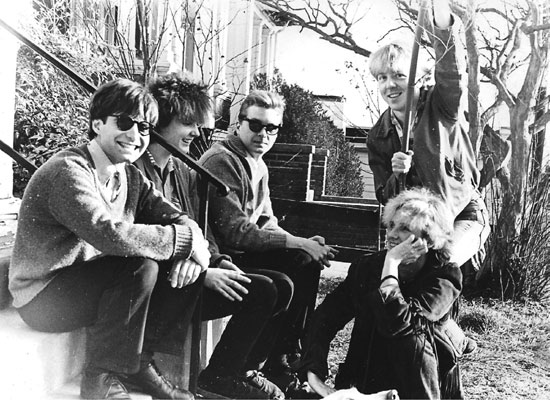
Let’s Active with some famous friends
He admits that when the band was interviewed, questions inevitably took the form of asking Hunter and Romweber things like, “What’s it like being a woman in a band?” Easter says that he understands why people asked, “but it was still a ridiculous question.”
Let’s Active would become known for having a collective personality best described as cuddly. Part of that came from the fetching good looks of the three musicians – they looked like the slightly nerdy kids next door, but with way-cooler hair – and some of it came by way of an infamous music video shot for MTV.
Debuting in March 1983 on the relatively new cable channel MTV, I.R.S. Presents the Cutting Edge was a means to provide exposure to artists who – at the time – were on the fringes of what was considered commercially viable. Let’s Active appeared on the program, performing “Every Word Means No.”
Easter recalls that when it came time to make the video, the band was told, “If you guys have any ideas for the way you want to do this, you know, cool.” And he notes that all three musicians liked dogs, so…they asked for dogs. But what they got were puppies. “They were adorable,” Easter admits. “So, they’re in there, and that adorable factor – and the way we look sort of like Smurfs – definitely cast us a [certain] way for all eternity.”
That video was recorded just after the band signed a record deal. And R.E.M. played an important role in helping make that happen. “[Through them] we got to cross paths with some of the people who worked at I.R.S. [Records],” Easter says. The group signed with Miles Copeland’s label in time to release Afoot, made as a demo tape and originally planned for release on a local indie label. “Maybe the R.E.M. guys gave the I.R.S. people a little nudge or whatever,” he says with shrug. “I don’t really know.”
About the Author

Bill Kopp
With a background in marketing and advertising, Bill Kopp got his professional start writing for Trouser Press. After a stint as Editor-in-chief for a national music magazine, Bill launched Musoscribe in 2009, and has published new content every business day since then (and every single day for several years). The more than 5000 interviews, essays, and reviews on Musoscribe reflect Bill's keen interest in American musical forms, most notably rock, jazz, and soul. His work features a special emphasis on reissues and vinyl. Bill's work also appears in many other outlets both online and in print. He regularly hosts lecture/discussions on artists and albums of historical importance (including monthly events Music to Your Ears and Music Movie Mondays), and is a frequent guest on music-focused radio programs and podcasts. In Spring 2023 he taught a history of Rock 'n' Roll at UNC Asheville's College for Seniors. He also researches and authors liner notes for album reissues -- some 40 to date -- and co-produced a reissue of jazz legend Julian "Cannonball" Adderley's final album. His first book, Reinventing Pink Floyd: From Syd Barrett to The Dark Side of the Moon was published by Rowman & Littlefield in 2018, and in paperback in 2019. His second book, Disturbing the Peace: 415 Records and the Rise of New Wave, was published in 2021 by HoZac Books. His third book, What's the Big Idea: 30 Great Concept Albums is available now. Read even more about him here.