
DEVO’s Duty Now for the Future: Mutate, Don’t Stagnate (Part 4 of 4)
Continued from Part Three…
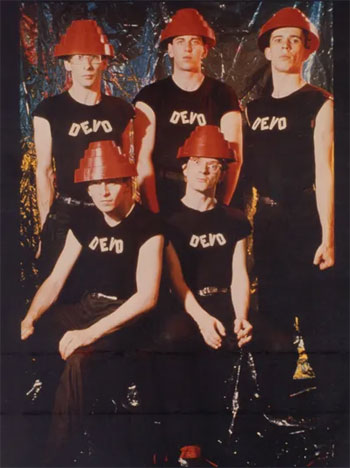 DEVO has its Theory of Devolution. The Residents have their Theory of Obscurity. Very different groups, but both are examples of radically unique artists building their work upon a philosophy. And that’s something that most bands don’t do. Do you think of the Residents and DEVO as kindred spirits?
Mark Mothersbaugh: Oh, yeah. There are a lot of bands out there that are even farther away from us that I think of that [way]. Some of them that are close, like Der Plan and other bands in Germany. But even people like the B-52s in the sense that they were artists, and then they created something with a concept. Fred and the girls don’t sound like any other band when they sing; they always hit their mark.
We toured with them last year, and it was delightful. DEVO is kind of crotchety and cynical; we’ve got that darker thing going. They’re lighter and more carefree; somehow it was really complimentary, and I think the audiences really enjoyed it.
Kids now, they research stuff. They don’t have to go to the record store and go find the box with other stuff in it. They can just go online and find things. And in the last few years, I’ve noticed that kids [at concerts] are singing along with me. And I’m like, “These kids! Their parents were babies when I was writing this stuff!”
Maybe it’s possible that this is a time where kids and adults are getting the DEVO message more than they did first time around. The first time around, Warner Brothers [Records] didn’t get it. I remember going into a marketing meeting for our first album. We’re sitting at a table, and they go, “Okay, here’s what we’re going to do. We’re going to print life-size cutouts of you guys and put them in all the important record stores.” And we asked, “How much will that cost?” They said, “$5,000.”
And Jerry said, “Could we have that money to make a film for one of the songs?” They just looked at us like, “What would we do with that?” They had no idea why we thought that was a good idea.
We touched on this briefly at the beginning of our conversation. For a long time, the Kent State killings seemed – for those of us who weren’t there, though I know you were – like something that was “in the past.” Recent events [ICE agents killing two Americans] make it clear that’s not the case. I know a concert experience is supposed to be about having fun. Does DEVO get its social commentary across in its live performances?
I think there’s some of both. We’re not beating people over the heads. De-evolution? We’re just bringing it up and telling people, because some people will never give a hoot. And then some of them, they want to know. I think it’s there in the message; songs like “Jocko Homo” and others, it’s kind of like, “What the heck is that about?” if you don’t know the song.
And even in the live show, we added footage that inspired us. Some of it was from the ‘30s, some from the ‘50s, in the middle of Yokohama. We show footage of Island of Lost Souls. There’s the mad scientist who’s trying to do surgery on jungle animals to evolve them, but it doesn’t quite work. And as Bela Lugosi says at one point, “We’re not humans, we’re not animals. We’re things!” And then when they start getting all upset, the scientist cracks a whip and says, “What is the law? Not to spill blood.” And they all come to attention: “Are we not men?” I remember hearing that, and then seeing shadows of the half-animals trudging past the House of Pain, which is what they called his laboratory. And I was like, “That looks like 5 o’ clock when work’s out at Goodyear!” And that inspired me for “Jocko Homo.”
The first time you ever see the word “devo” is in 1954, in the movie Inherit the Wind. It’s about the Scopes monkey trial, this court case where they’re trying this teacher for teaching children evolution instead of the Bible. There’s a scene where it’s turned into a carnival. You hear carnival music, and a guy is pointing: There’s a chimpanzee sitting on a counter. And behind him [a sign reads] “The Devolution Man.”
And this guy’s going, “Ladies and gentlemen, is this an ancestor of yours? Is this possibly a relation?” And as he’s making fun of evolution, the camera comes in close and you see the monkey sitting and playing with a cigarette. And on one side of him it reads, “Devo.” And “lution” is blocked by his body, so it reads “Devo Man.”
So we put that up on the screen. People may not know what the movies are, but they’re going, “That’s old stuff!”
There are those people who in the last few years came up with their attacks on the immigrants: “They’re eating the dogs, they’re eating the cats!” The same people who are making up those lies, made up the de-evolution lies back then. So when we first heard about de-evolution, we said, “Instead of making fun of it, what if we talked about it like it was a reality?” And that’s where it came from.
You may also enjoy…
- My 2023 interview with DEVO’s Gerald Casale
- Another feature based my my interview with Casale
- My 2018 review essay: DEVO’s Debut Album at 40
About the Author

Bill Kopp
With a background in marketing and advertising, Bill Kopp got his professional start writing for Trouser Press. After a stint as Editor-in-chief for a national music magazine, Bill launched Musoscribe in 2009, and has published new content every business day since then (and every single day for several years). The more than 5000 interviews, essays, and reviews on Musoscribe reflect Bill's keen interest in American musical forms, most notably rock, jazz, and soul. His work features a special emphasis on reissues and vinyl. Bill's work also appears in many other outlets both online and in print. He regularly hosts lecture/discussions on artists and albums of historical importance (including monthly events Music to Your Ears and Music Movie Mondays), and is a frequent guest on music-focused radio programs and podcasts. In Spring 2023 he taught a history of Rock 'n' Roll at UNC Asheville's College for Seniors. He also researches and authors liner notes for album reissues -- some 40 to date -- and co-produced a reissue of jazz legend Julian "Cannonball" Adderley's final album. His first book, Reinventing Pink Floyd: From Syd Barrett to The Dark Side of the Moon was published by Rowman & Littlefield in 2018, and in paperback in 2019. His second book, Disturbing the Peace: 415 Records and the Rise of New Wave, was published in 2021 by HoZac Books. His third book, What's the Big Idea: 30 Great Concept Albums is available now. Read even more about him here.