
Remembering the Raspberries, Part 4 of 4
Continued from Part Three…
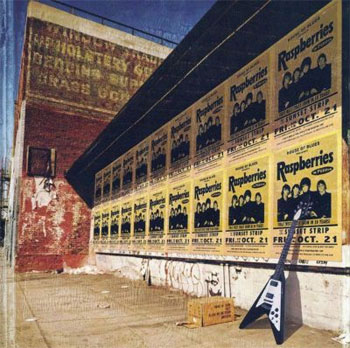 Raspberries Remembrance
The idea for a Raspberries tribute album came more than three years ago from Fernando Perdomo. The multi-instrumentalist and producer is among the busiest and most in-demand session players in rock and pop, with a deep catalog and an astoundingly long list of credits. Perdomo approached Ken Sharp with his idea. “Initially, I wasn’t sure about it,” Sharp says. “My deep passion for the Raspberries would not allow me to be involved on any level unless it was [100%].” Perdomo enthusiastically agreed, and work got underway.
For many of the album’s songs, Sharp and Perdomo laid down basic tracks. Sharp can be heard on electric and acoustic guitars, piano, celeste, ukulele, various percussion and more. Perdomo – who can play every instrument with dazzling skill – contributed drums, sitar and many other parts. Sharp even convinced Jim Bonfanti to get involved. “He plays drums on four songs on the album,” Sharp says with visible pride.
Sharp sent the unfinished tracks to the artists who would then add their vocals and/or additional instrumentation. Several of the acts contributing to Play On – Rick Springfield, the Lemon Twigs, the Spongetones, Robin Taylor Zander, Darian Sahanaja, Bird Streets, Popdudes, Parthenon Huxley, Shoes and several others – handled their own recordings start to finish, using their own personnel.
As with any various-artists tribute project, Play On is a mixed bag. Some artists take a reverent approach, turning in covers of Raspberries classics that closely follow the original arrangements and style. Others take the songs in a new direction. Ultimately, that variety is one of the strengths of Play On.
Highlights of the latter approach include Tori Holub’s reading of “Starting Over.” Over subtle instrumental backing by Sharp on multiple instruments – Mellotron, guitars, bell tree – Holub turns in a sublime vocal that strongly calls to mind Karen Carpenter. “Tori’s in her early 20s and hadn’t really heard of the Raspberries,” Sharp says. “But she loved the song.”
So did Eric Carmen. “After the last conversation I had with Eric, he sent me a voice message,” Sharp says. “He said, ‘I really love this version; her voice is beautiful. It doesn’t sound like the Raspberries, and it shouldn’t.’”
Released as the Raspberries’ final single in 1975, “Cruisin’ Music” failed to chart anywhere. But with its lyrics and vocal arrangement both nodding to the Beach Boys, it’s a favored track among serious fans. For Play On, Ronnie D’Addario – father of the Lemon Twigs and an accomplished recording artist in his own right – leaned even more heavily into the Beach Boys vibe for his reading of the tune. The result is one of the strongest tracks on the entire 37-song collection.
 Yet there are many tracks vying for that distinction. Tackling the dramatic “I Can Remember” calls for a formidable vocalist, and few can compare with Karla DeVito. With instrumental backing from Sharp, Perdomo, Sahanaja and Billy Sullivan – the latter a touring musician with the Raspberries for their 2004 to 2007 live dates – DeVito turns in a breathtaking, bravura performance that rivals the original.
A few surprises make the solid album even better. John Lennon called The Hudson Brothers “the kings of Saturday morning” in the ‘70s; Mark, Bill and Brett scored hits with their sophisticated pop, and hosted a popular CBS TV series, The Hudson Brothers Razzle Dazzle Show. The trio released six albums between 1972 and 1980, and landed four singles on Billboard’s Hot 100. But the group split in 1981 and hadn’t been heard from since. So the unexpected reappearance of the three brothers for the rocking “All Through the Night” (originally heard on Starting Over) is a treat. Bringing things full circle, the Hudson Brothers are joined by Randy Klawon (of the Choir and Cyrus Erie) on the recording.
Raspberries Respect
“The Raspberries were among the first and most prominent artists with a ‘manifesto’ approach to power pop,” says Justin Fielding, director of the authoritative, long-gestating and eagerly awaited documentary The Power Pop Movie. He summarizes that manifesto: “’We don’t like where music is going. We want more great records like we got in the 1960s… and we’re going to make them.’ And they did!”
Asked to reflect on the Raspberries’ legacy, Scott McCarl is stumped. “That’s for others to say,” he offers. “I’m just glad we’re remembered.” Jim Bonfanti is pleased that his old group is continually cited by younger artists as an influence. “We have a large family of musicians in the power pop genre who say we’ve influenced them in some way,” he notes. “That’s the thing that people should remember. Whether we ever get into the Rock and Roll Hall of Fame, we were there at the beginning of that.”
POSTSCRIPT: Bonus Bit…
Scott McCarl addresses another bit of Raspberries lore: rumors that John Lennon had a hand in the mixing of “Overnight Sensation.” “I only know what I heard,” he says. “We weren’t there for the mix.” In those days, track mixing was neither computerized nor automated. “There were all these tough fader moves on the 24-track [console] that needed to happen in that mix,” he says, and the story goes that Lennon happily jumped in to help producer Jimmy Ienner.
The story holds up to scrutiny; sessions for Starting Over took place at New York City’s Record Plant. And at the same time, Lennon – in his capacity as producer – held some of the sessions for Harry Nilsson’s Pussy Cats album in the same studio. “We had more and more contact with [John] as the days went by, so it sure is possible,” McCarl says. “Eric and Wally even sang on a chorus of one of the songs he was producing.” He recalls an actual motorcycle being wheeled into the studio for Nilsson’s reading of “Rock Around the Clock.” “They were doing huge figure-eights around the Studio A floor,” he says. “When they opened the doors afterward, the exhaust smoke came billowing out of the room!”
About the Author

Bill Kopp
With a background in marketing and advertising, Bill Kopp got his professional start writing for Trouser Press. After a stint as Editor-in-chief for a national music magazine, Bill launched Musoscribe in 2009, and has published new content every business day since then (and every single day for several years). The more than 5000 interviews, essays, and reviews on Musoscribe reflect Bill's keen interest in American musical forms, most notably rock, jazz, and soul. His work features a special emphasis on reissues and vinyl. Bill's work also appears in many other outlets both online and in print. He regularly hosts lecture/discussions on artists and albums of historical importance (including monthly events Music to Your Ears and Music Movie Mondays), and is a frequent guest on music-focused radio programs and podcasts. In Spring 2023 he taught a history of Rock 'n' Roll at UNC Asheville's College for Seniors. He also researches and authors liner notes for album reissues -- some 40 to date -- and co-produced a reissue of jazz legend Julian "Cannonball" Adderley's final album. His first book, Reinventing Pink Floyd: From Syd Barrett to The Dark Side of the Moon was published by Rowman & Littlefield in 2018, and in paperback in 2019. His second book, Disturbing the Peace: 415 Records and the Rise of New Wave, was published in 2021 by HoZac Books. His third book, What's the Big Idea: 30 Great Concept Albums is available now. Read even more about him here.