
Remembering the Raspberries, Part 3 of 4
Continued from Part Two…
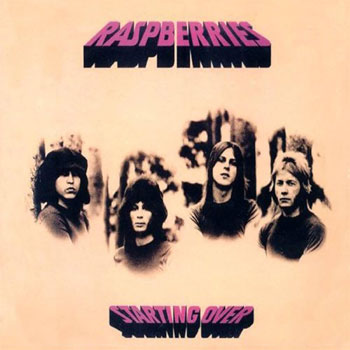
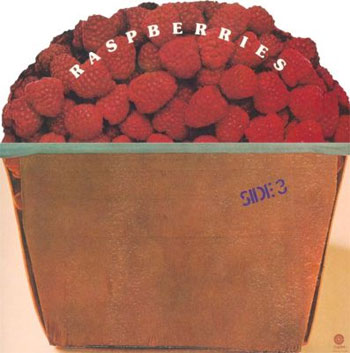 The new lineup of Raspberries made what would be the band’s final album of original material. Though Starting Over is fondly remembered today, on its September 1974 release, the Raspberries’ fourth LP lingered in the lower reaches of the Billboard 200, peaking at No. 143. The album did feature a signature tune, the power pop-meets-progressive mini-epic “Overnight Sensation (Hit Record).”
Released as a single, that tune made it to No. 18 on Billboard’s chart. The disappointing commercial performance of the Raspberries’ fourth album demoralized the group. “As Wally likes to say, ‘We were starting to be over,’” McCarl quips. He points to some of the same strong-personality issues that Bonfanti mentions, while noting that from his perspective, founding members Carmen and Bryson were the band’s co-leaders. “I don’t know if we were – or could ever have been – a democratic and equitable foursome.”
The group broke up in April 1975. just seven months after the release of Starting Over. “I guess it couldn’t last,” McCarl says. “Too young, too high-strung.”
Post-Raspberries, Carmen embarked on a solo career dotted with successes. The lush, soft rock of “All By Myself” and “Never Gonna Fall in Love Again” were a far cry from the rocking character of the Raspberries’ biggest hits, but both went Top 40. Carmen’s next major success was “Hungry Eyes,” a pop hit featured on the soundtrack of 1987’s Dirty Dancing. Released as a single, the track reached No. 4 on Billboard’s Hot 100.
Meanwhile, the Raspberries’ legacy continued to grow. Capitol compiled the band’s biggest hits and best-loved album tracks on a succession of releases throughout the 1980s and into the ‘90s. In 1996, RPM Records repackaged the band’s four-album catalog into a pair of CD releases; their titles – Power Pop Volume One and Volume Two – underscored the group’s status as leading lights in that genre.
Bonfanti says that for a long time after he left – and after the band broke up – neither he nor his old band mates were aware of just how influential the Raspberries were. “In the days before the Internet, those kinds of things took longer to get around,” he says with a laugh. Eventually he learned that Bruce Springsteen and Paul Stanley counted themselves as Raspberries fans. “And we kept learning of more and more,” he says.
 Raspberries Redux
By the end of the ‘90s, the founding quartet of Bonfanti, Carmen, Bryson and Smalley reunited for a one-off gig; not long thereafter Bryson and Smalley reunited with McCarl and released an EP. And in 2004, the seeds for a proper reunion were sown. Bonfanti recalls how the unexpected came about: “A talent buyer called me up on an August night, introduced himself and told me, ‘We’re building this club, and we’d really like the Raspberries to open it.’”
Bonfanti says he explained that a reunion wasn’t likely, but promised to bring the offer to his former bandmates. “I went to Eric first,” he says. “Because without him, there’s no Raspberries.” Carmen was cautiously open to the idea. “I went to Wally next, because without [me] and Eric, there’s no Wally, and there’s no band.” Ultimately everyone agreed, and in November the Raspberries played Cleveland’s new House of Blues. That successful reunion led to a tour, a VH-1 Classic special and eventually two live albums, Live on Sunset Strip in 2007 and Pop Art Live (2017).
Most fans who would have seen the band live during its original 1970-75 run in that era are now approaching 70. Ken Sharp – author of the exhaustive, 800-plus page biography of the group, Overnight Sensation: The Story of the Raspberries – was too young to have seen the band in those days. But he would lose count of just how many times he witnessed the band live onstage in the 21st century.
He even got the opportunity to play with the band.
Sharp first discovered the Raspberries’ music during his college years in the ‘80s, nearly a decade after the band’s first run had ended. “I was working at a radio station in Philly, and the production director Bob Stroud was turning me on to different records,” he recalls. One of those records was Starting Over. “The first song he played was ‘I Don’t Know What I Want,’ and I was like, ‘Oh my god!’” He says that the Raspberries’ catalog hit every sweet spot for him.
In time, that interest became a consuming passion, and Sharp wrote the first edition of his Raspberries biography in 1993. Multiple revisions would follow; the latest, greatly expanded edition appeared in 2025. “It’s like a giant phone book,” Sharp laughs.
Ken Sharp would be in the audience for both of the shows subsequently documented on live releases. Because of his deep knowledge of the band, he was tapped to handle advance publicity for the concerts. As a way of expressing thanks, Eric Carmen asked Sharp what the band could do to pay him back. “I wouldn’t accept any money,” Sharp says, “but when they wouldn’t accept ‘no’ for an answer, I said, ‘I’d love to play my favorite song with you at rehearsal.’”
Carmen and his band mates agreed, so Ken Sharp joined them at SIR the day before the Sunset Boulevard gig, playing “Tonight” from Side 3. “I was the fifth Raspberry for about three and half minutes,” he says with a broad grin. “And let me tell you: it was joyous.”
The group continued with live dates into 2007, after which the member returned to their lives as before. Carmen’s death in 2024 closed the book on the possibility of any future Raspberries reunions. But the story wasn’t quite over.
Jim Bonfanti recalls hearing a song in 2024 by the Lemon Twigs and being impressed. “I gotta go see these guys,” he thought. When the band scheduled a Cleveland date, he made sure to attend. “Wally was there, too,” he says. “They did a Raspberries song, and they even did a song by the Choir. I went over to Wally, and said, ‘This is what we started.’”
About the Author

Bill Kopp
With a background in marketing and advertising, Bill Kopp got his professional start writing for Trouser Press. After a stint as Editor-in-chief for a national music magazine, Bill launched Musoscribe in 2009, and has published new content every business day since then (and every single day for several years). The more than 5000 interviews, essays, and reviews on Musoscribe reflect Bill's keen interest in American musical forms, most notably rock, jazz, and soul. His work features a special emphasis on reissues and vinyl. Bill's work also appears in many other outlets both online and in print. He regularly hosts lecture/discussions on artists and albums of historical importance (including monthly events Music to Your Ears and Music Movie Mondays), and is a frequent guest on music-focused radio programs and podcasts. In Spring 2023 he taught a history of Rock 'n' Roll at UNC Asheville's College for Seniors. He also researches and authors liner notes for album reissues -- some 40 to date -- and co-produced a reissue of jazz legend Julian "Cannonball" Adderley's final album. His first book, Reinventing Pink Floyd: From Syd Barrett to The Dark Side of the Moon was published by Rowman & Littlefield in 2018, and in paperback in 2019. His second book, Disturbing the Peace: 415 Records and the Rise of New Wave, was published in 2021 by HoZac Books. His third book, What's the Big Idea: 30 Great Concept Albums is available now. Read even more about him here.