
Album Review: Mitch Woods – Mitch Woods’ Happy Hour
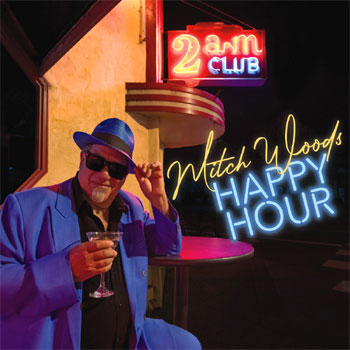 Brooklyn-born, Bay Area-based pianist, singer and bandleader Mitch Woods has been making music for more than four decades. With his band the Rocket 88s, he has served up album after tasty album, showcasing his trademark mix of boogie woogie, rollicking New Orleans jazz, postwar jump blues and swing, and proto-rock ‘n’ roll. He brings it all together for this new live-in-the-studio set.
On one level, his latest effort, Mitch Woods’ Happy Hour can be seen as a kind of victory lap: it picks and chooses from Woods’ repertoire for a greatest-hits set list. But Woods is nowhere hear the end of his career, and Happy Hour is more than a look back. For this album, Woods gathered his team – bassist Kedar Roy, sax man Dave Somers, drummer Larry Vann and guitarist/engineer Kid Andersen – for a pandemic-era live session.
With all their shots up to date and masks on their faces, the group convened in Andersen’s famed Greaseland Studios in San Jose, set up their instruments, and just played. The music on Mitch Woods’ Happy Hour is the product of those five musicians playing at the same time, in sight of each other, with all of the energy and interplay that comes from such an approach.
All of the songs on Happy Hour – a baker’s dozen of Woods originals – have appeared on previous releases. But the readings of the songs here are closest to what one would experience at a live show, with the improved sonics of a recording studio to boot. As Woods’ artistry is so widely encompassing, the songs transcend a particular style; Happy Hour is a musical travelogue through the music that has informed his artistry, distilled through his original songwriting.
“Jukebox Drive” swings hard, with a spoken-sung vocal that recalls Louis Jordan, one of Woods’ heroes. The arrangement bridges Jordan’s ‘40s sound with a hard-charging 1950s rock vibe; the latter quality is emphasized by Andersen’s spirited guitar solo, and Somers’ horn pulls things back toward the 1940s. Sly lyrical references to pop culture phenomena of those eras are the cherry on top.
As its title telegraphs, “Long, Lean and Lanky” is of a piece with “Jump Jive and Wail,” “Flip Flop and Fly,” “Shake Rattle and Roll” and the like. But Woods’ approach to the style is so genuine, so heartfelt, that it doesn’t feel like a pastiche: like Mitch Woods, it’s the real deal. And his exuberant work on the ivories is a treat.
“Broke” is a hilarious tune in the Jordan mold, with mischievous dialogue and wonderful gang vocals. The song is stuffed with Jordanesque turns – the snare hits signifying a knock at the door, sassy vocal phrasing and an overdubbed horn section that truly slams. Multiple rings of the cash register underscore the tune’s laugh-riot quality.
New Orleans heroes Fats Domino and Huey “Piano” Smith get a tribute of sorts with Woods’ delightful “Hattie Green”; while there’s a strong ensemble quality to the album, on this track Woods takes center stage and shows off his ace piano work. And tracks like “Solid Gold Cadillac” make the point that – thanks to the music and production methods – Mitch Woods’ Happy Hour sounds like the best-recorded late ‘40s / early ‘50s album you’ve ever heard.
About the Author

Bill Kopp
With a background in marketing and advertising, Bill Kopp got his professional start writing for Trouser Press. After a stint as Editor-in-chief for a national music magazine, Bill launched Musoscribe in 2009, and has published new content every business day since then (and every single day for several years). The more than 5000 interviews, essays, and reviews on Musoscribe reflect Bill's keen interest in American musical forms, most notably rock, jazz, and soul. His work features a special emphasis on reissues and vinyl. Bill's work also appears in many other outlets both online and in print. He regularly hosts lecture/discussions on artists and albums of historical importance (including monthly events Music to Your Ears and Music Movie Mondays), and is a frequent guest on music-focused radio programs and podcasts. In Spring 2023 he taught a history of Rock 'n' Roll at UNC Asheville's College for Seniors. He also researches and authors liner notes for album reissues -- some 40 to date -- and co-produced a reissue of jazz legend Julian "Cannonball" Adderley's final album. His first book, Reinventing Pink Floyd: From Syd Barrett to The Dark Side of the Moon was published by Rowman & Littlefield in 2018, and in paperback in 2019. His second book, Disturbing the Peace: 415 Records and the Rise of New Wave, was published in 2021 by HoZac Books. His third book, What's the Big Idea: 30 Great Concept Albums is available now. Read even more about him here.