
The Avett Brothers and ‘Swept Away’ – Banjos on Broadway or, Quite a Concept to Digest (Part 2 of 2)
Continued from Part One…
In Logan’s hands, Swept Away is a morality tale with religious (or quasi-religious) themes of salvation at its core. “We were [pleasantly] surprised at how on-the-mark John was about concepts that are very alive in our own dialogue,” says Seth. “The brotherhood—the relational nuances—are spot-on,” Scott adds.
The 90-minute production is split roughly in half; the first part features the four main characters (each referred to in generic terms—Big Brother, Little Brother, Captain, Mate—rather than by name) plus a spirited ensemble of crew members aboard a whaling boat that sets sail from New Bedford, Massachusetts. The music hews fairly closely to the Avett Brothers’ original arrangements, with lyrical and instrumental adjustments made to accommodate the vocal-forward nature of a stage production.
Occasionally, the songs take an anachronistic turn. With its back-and-forth shift between bluegrass and rock, “Ain’t No Man / Lord Lay Your Hand” recalls the Charlie Daniels Band’s similarly-themed 1979 single “The Devil Went Down to Georgia.” But largely, the music remains true to the spirit of a story set nearly 150 years ago.
Swept Away premiered in 2022 with performances in Berkeley, California; since then the show has traveled to Washington, D.C., with no changes to the cast’s core lineup. Actor-singer Stark Sands (Big Brother) notes that the cast has mounted 128 productions. “And that was before we started on Broadway,” he adds. Three weeks of preview performances for the seasoned cast came ahead of Swept Away’s Broadway premiere on November 19 at Manhattan’s Longacre Theatre.
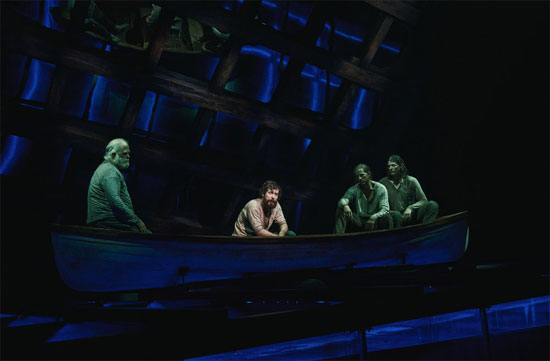
Bob Crawford suggests that the show’s inventive set is almost a fifth main character. “It speaks with incredible boldness,” he says. (Details on what he means are best discovered when seeing the performance.) But beyond the scenery and the Avett Brothers’ rousing music, the true stars of the show are the four actor-singers leading the all-male cast. Wayne Duvall (Captain) develops his role beyond what Logan’s book provides for it. “My character goes from melancholy to despair to death,” he says. “It’s a deep freakin’ show, man. It tackles so many different [topics] for each one of us, separately and together.”
John Gallagher Jr.’s Mate is the lead among equals in Swept Away. “It’s quite vocally demanding,” he says. “And it takes a real emotional toll to live through [the story] eight times a week.” Sands emphasizes that all of the major roles—his included—require the actors to “go to some really dark places mentally, but there’s redemption. We get lifted up at the end of the show.”
Adrian Enscoe (Little Brother) admits that “what happens in the show is quite traumatic, but it leaves you with a sense of hope.” Enscoe laughs while explaining that there are other theater works that seek to disturb the audience. “You go home, your stomach is turning: ‘What the hell did I just see!?’” The actor says that Swept Away is different. “The show puts you through a catharsis,” Enscoe concedes. “When people come out afterward, it’s like they’ve just had a religious experience. And that’s how it feels for us on stage, too.”
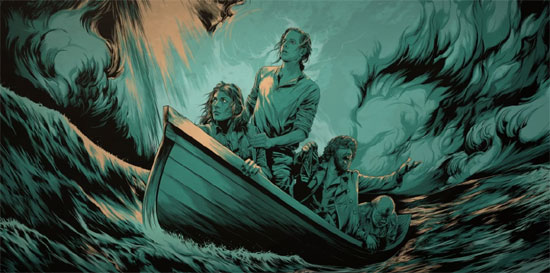
The expert staging and inventive set work serve to add to the emotional intensity of the story adapted from the Avett Brothers’ adaptation of a real-life tragedy. But the tale twice removed still holds great power. “I want people to be in that little boat with us,” says Duvall. “I want them to forget that they’re sitting in a theater, and to come away with whatever they truly need or feel.”
“We’re all in this together,” says Adrian Enscoe, referring as much to the cast as to humanity as a whole. “The poetry of being on this boat fits into the larger world: you never know what adversity is around the corner. The only thing that we have in this world is each other; we have to rely on each other existentially to pull through our darkest moments.”
Gallagher observes that any theater staging is a leap of faith. “And that’s true for each of our characters,” he says. “There’s a massive leap of faith that everyone has to take at some point in the show. You just hope you’ll land somewhere soft. And my hope is that every audience member takes the same risk: to jump as if they’ll be caught.” “My wish,” says Sands, “is that people would walk away from the show with an appreciation for their own lives, for the people that they love. And I think Swept Away has the ability to do that.”
The Avett Brothers are pleased with how Swept Away has taken on a life of its own beyond their music. “I love how high the highs get, how low the lows get,” Scott Avett says. “There’s a great element of dynamism in Swept Away; that’s something that we’re attempting in our own shows—and in our everyday lives—as well.”
About the Author

Bill Kopp
With a background in marketing and advertising, Bill Kopp got his professional start writing for Trouser Press. After a stint as Editor-in-chief for a national music magazine, Bill launched Musoscribe in 2009, and has published new content every business day since then (and every single day for several years). The more than 5000 interviews, essays, and reviews on Musoscribe reflect Bill's keen interest in American musical forms, most notably rock, jazz, and soul. His work features a special emphasis on reissues and vinyl. Bill's work also appears in many other outlets both online and in print. He regularly hosts lecture/discussions on artists and albums of historical importance (including monthly events Music to Your Ears and Music Movie Mondays), and is a frequent guest on music-focused radio programs and podcasts. In Spring 2023 he taught a history of Rock 'n' Roll at UNC Asheville's College for Seniors. He also researches and authors liner notes for album reissues -- some 40 to date -- and co-produced a reissue of jazz legend Julian "Cannonball" Adderley's final album. His first book, Reinventing Pink Floyd: From Syd Barrett to The Dark Side of the Moon was published by Rowman & Littlefield in 2018, and in paperback in 2019. His second book, Disturbing the Peace: 415 Records and the Rise of New Wave, was published in 2021 by HoZac Books. His third book, What's the Big Idea: 30 Great Concept Albums is available now. Read even more about him here.