
The Avett Brothers and ‘Swept Away’ – Banjos on Broadway or, Quite a Concept to Digest (Part 1 of 2)
 A lightly edited version of this feature – with a different title – appeared previously in SPIN.
In the 1880s, a yacht sank off South Africa’s Cape of Good Hope. The few survivors resorted to cannibalism before their rescue.
That grisly tale might seem an unlikely theme upon which to build a concept album; one might perhaps expect such a thing from the likes of Slipknot, Cannibal Corpse or Alice Cooper. But Seth Avett saw something deeper in the story’s themes. “The truth-telling aspect of the story was intriguing to us,” he explains. “It’s intrinsically sewn into the idea of songwriting, and of making things that you can feel good about sharing over and over again.”
The Avett Brothers—Seth and his brother Scott—were inspired by the story, which would eventually become their third studio LP, the 2004 concept album Mignonette.
The Avett Brothers come from a musical family tradition. Growing up near metropolitan Charlotte in Concord, North Carolina, the Avetts got into music early. By the time they reached high school, Seth (guitar) and Scott (banjo) had teamed up. The rock music (with a punk edge and attitude) they had been playing informed their collaborative venture, but the music of the Avett Brothers drew as much from traditional forms like bluegrass and country. Their synthesis of those styles resulted in something unique.
By 2001, Bob Crawford had joined on bass (though all members play multiple instruments and sing). With those three as the core of the group, the Avett Brothers made a self-released live album. That release caught the public’s attention; it also drew the attention of Dolph Ramseur, head of Ramseur Records. The Avett Brothers signed with the label and released their studio debut, Country Was in 2002.
The idea of a concept album – a collection of songs with a unified theme or even a narrative – has a proud tradition in and beyond rock. And The Avett Brothers were inspired by that tradition as well. Scott Avett cites two albums – both by Willie Nelson – as foundational works for him. “Yesterday’s Wine [1971] and Red Headed Stranger [1975] were definitely models that we recognized,” he says, noting that Pink Floyd’s 1979 double LP The Wall was an influence as well.
Scott says that Mignonette didn’t actually start out as a concept album. “We were going to make an album one way or the other,” he says. Seth emphasizes that in his view, all of The Avett Brothers albums are conceptual. “And we’re the concept,” he says. “The songs that Scott and I write are autobiographical in nature, but they also speak on the human experience.”
Scott believes that the act of making a conceptual work is creatively liberating. “It gives the artist permission to break out of the boundaries of what they think of as songs,” he says. The storytelling and dialogical quality built into the bluegrass tradition lent itself brilliantly to the Avetts’ narrative songs. Mignonette was a critical smash.
At the time, the album was merely one of a long string of acclaimed releases from the band. By 2020, the Avett Brothers had 10 studio sets and four live albums to their credit; the songs from Mignonette were now a small part of a large and beloved body of work.
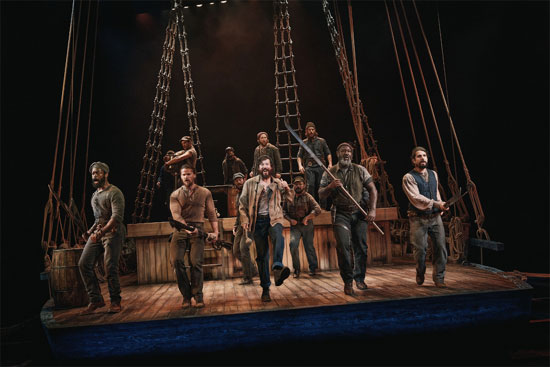
That changed in 2014, when Matthew Masten—associate producer of a 2014 Broadway adaptation of John Steinbeck’s classic Of Mice and Men—approached the group with the idea of making a musical based on their then decade-old album. Musical productions with cannibalism as part of the story line are uncommon but not without precedent: years before creating South Park, writers Matt Parker and Trey Stone created a stage production called Cannibal! The Musical. But that was a comedy; what Masten had in mind was something far more thoughtful and serious.
Scott says that he and his band mates had no doubts about the validity of the idea. “We were excited,” Seth agrees. “We thought, ‘Hey, maybe this could happen.’” They emphasize that playwright and screenwriter John Logan (Gladiator, Tim Burton’s Sweeney Todd: The Demon Barber of Fleet Street, the James Bond films Skyfall and Spectre) was a major source of dedication and inspiration.
Logan’s book for the stage production used Mignonette as a springboard, but he drew from the group’s catalog for songs that would help tell the show’s story. In the end, five songs from that record would find their way into Swept Away; eight other tunes draw from four other albums, and the group composed one new song (“Lord Lay Your Hand On My Shoulder”) expressly for the stage show.
About the Author

Bill Kopp
With a background in marketing and advertising, Bill Kopp got his professional start writing for Trouser Press. After a stint as Editor-in-chief for a national music magazine, Bill launched Musoscribe in 2009, and has published new content every business day since then (and every single day for several years). The more than 5000 interviews, essays, and reviews on Musoscribe reflect Bill's keen interest in American musical forms, most notably rock, jazz, and soul. His work features a special emphasis on reissues and vinyl. Bill's work also appears in many other outlets both online and in print. He regularly hosts lecture/discussions on artists and albums of historical importance (including monthly events Music to Your Ears and Music Movie Mondays), and is a frequent guest on music-focused radio programs and podcasts. In Spring 2023 he taught a history of Rock 'n' Roll at UNC Asheville's College for Seniors. He also researches and authors liner notes for album reissues -- some 40 to date -- and co-produced a reissue of jazz legend Julian "Cannonball" Adderley's final album. His first book, Reinventing Pink Floyd: From Syd Barrett to The Dark Side of the Moon was published by Rowman & Littlefield in 2018, and in paperback in 2019. His second book, Disturbing the Peace: 415 Records and the Rise of New Wave, was published in 2021 by HoZac Books. His third book, What's the Big Idea: 30 Great Concept Albums is available now. Read even more about him here.