
Edge of the World: Let’s Active at 40 (Part 1 of 3)
 NOTE: This feature was originally commissioned by a print magazine in 2022, never to appear. After three years on that merry-go-round I’ve decided instead to publish it here on Musoscribe. Sincere thanks to Mitch Easter for having the patience of a saint. – bk
In the early 1980s, popular music was undergoing a sea change. To be sure, corporate mega-rock didn’t go away. But in the wake of punk and new wave, a new kind of music started to appear. Select cities in the American South – Athens, Atlanta, Chapel Hill and Winston-Salem among them – gave rise to alternative music scenes. From an early age, Mitch Easter had been at the center of the scene in Winston-Salem. And Let’s Active, the band he put together in 1981, would be an exemplar of the new sound and style.
Back in the early 1970s, American high schools had designated smoking areas; students could congregate there between classes for their nicotine fix. And it was in the “smoking pit” at a Winston-Salem junior high school where Mitch Easter first met Faye Hunter. “She never smoked,” Easter recalls, “but she hung out there. Her friends – and a lot of the ‘rock musicians’ – were in that pit.”
Hunter was a grade ahead of Easter. “At that age, that was like being ten years older,” Easter says. So they had been traveling in different circles. But some mutual friends with an appreciation for music insisted that Mitch and Faye should meet, so they did. “And she was great,” Easter days. “I really liked her.” Hunter came from a family that was engaged and immersed in what Easter describes as “’the scene,’ such as it was back then.” Faye and Mitch were into the same kinds of music, too. “She had that classic good setup of an older sibling with the cool records,” Easter says.
Their friendship came first; playing together in Let’s Active happened much later. During his high school years, Easter played with Sacred Irony and the Imperturbable Teutonic Griffin; semi-reunions of those fabled bands – both of which were minor legends back in Winston-Salem – took place in May 2018 at a gala event hosted by the Ramkat. That performance was captured on Yesterday’s Tomorrow: Celebrating the Winston-Salem Sound, released by Omnivore Recordings in 2021.
Easter was in yet another band during his high school years. Rittenhouse Square also featured his friends and classmates Peter Holsapple and Chris Stamey, both later of The dBs. After Easter graduated and went to University of North Carolina in Chapel Hill, he stayed busy with music. Like Holsapple and Stamey, he eventually made his way to New York City in hope of establishing a recording studio there.
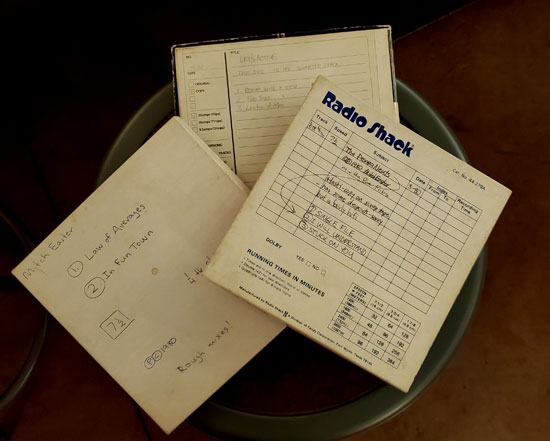
Peter Holsapple recalls that there was a plan that he, Easter, Stamey and (future dB’s bassist and guitarist) Gene Holder would form a collective in which they would back whichever among them scored a gig. But those plans didn’t materialize. At that point in New York City, Holsapple points out, “there were a lot of studios. So Mitch moved his [recording gear] back to his parents’ garage in Kernersville.”
Easter continued creating one-man-band recordings of his own music, but eventually decided to put a band together. Hunter quickly taught herself how to play bass.
Drummer Sara Romweber already had a good bit of experience playing in bands. Jefferson Holt was managing R.E.M., and both he and fellow musician and producer Don Dixon were convinced that Easter and Hunter should be introduced to Romweber. “Both of them said, ‘I think there’s this person who should be in your band,’” Easter recalls.
They met at The Station, a bar and music venue in Carrboro, N.C. “She was really nice,” Easter says, “But she was hesitant because she didn’t know us.” Eight or more years younger than Easter, Romweber was still in high school when they met. “We had to keep bugging her,” Easter says with a laugh. “But eventually we talked her into it. She did join, and it was essential.” And he emphasizes how important Hunter and Romweber were to the musical character of Let’s Active. “They were very distinctive players, and they just made us a little different,” he says. “They really made that thing be a thing.”
Easter makes the point that unlike most of his previous bands, Let’s Active was a fresh start. “This band did not evolve out of my previous band,” he says. And while Let’s Active was a vehicle for his songs, Easter says that those songs wouldn’t have gone anywhere without Hunter and Romweber. “I had always tried to write songs,” he explains. “I was always well aware that these songs I was writing were, on a formalistic level, songs, but they weren’t really catchy!”
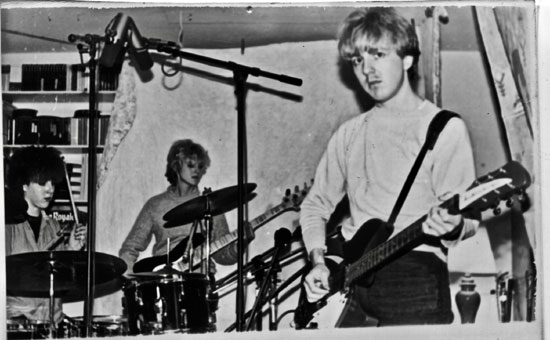 With Mitch Easter serving as producer, R.E.M. had recorded their debut single, “Radio Free Europe” at his Drive-In Studio in Winston Salem in early 1981. In the first week of October of that year, they would return to record their debut EP, Chronic Town, eventually released on I.R.S. Records. It was during those sessions that the band and Holt suggested that Easter’s new band open for R.E.M. at an upcoming gig.
“They knew that I’d started my little band,” Easter says. “And they said, ‘Well, if you want to play with us in three weeks, we’ve got a show in Atlanta.’ We really didn’t have it together, but we got it together and did that show.”
That first Let’s Active gig – at Atlanta’s legendary 688 opening for friends R.E.M. – included an early composition requiring an electric sitar, which Easter just happened to have handy. He notes that R.E.M. guitarist Peter Buck was known for getting up onstage with whatever other band was on the bill. “I have this great recording of us doing this song which nobody could just jump up and play,” he laughs. “It has a million chords in it, but Peter was just going for it on the sitar. And it’s hilarious!”
Working with Sara and Faye sparked something in Easter. “I had had these demos where I did everything,” he says. “And those were some of the first songs we played.” But by the time the trio went into his Drive-In Studio to record the six songs that would be released as Let’s Active’s debut EP Afoot, the trio was playing all new material. “I don’t think anything on that EP was written before the band was formed,” he says.
About the Author

Bill Kopp
With a background in marketing and advertising, Bill Kopp got his professional start writing for Trouser Press. After a stint as Editor-in-chief for a national music magazine, Bill launched Musoscribe in 2009, and has published new content every business day since then (and every single day for several years). The more than 5000 interviews, essays, and reviews on Musoscribe reflect Bill's keen interest in American musical forms, most notably rock, jazz, and soul. His work features a special emphasis on reissues and vinyl. Bill's work also appears in many other outlets both online and in print. He regularly hosts lecture/discussions on artists and albums of historical importance (including monthly events Music to Your Ears and Music Movie Mondays), and is a frequent guest on music-focused radio programs and podcasts. In Spring 2023 he taught a history of Rock 'n' Roll at UNC Asheville's College for Seniors. He also researches and authors liner notes for album reissues -- some 40 to date -- and co-produced a reissue of jazz legend Julian "Cannonball" Adderley's final album. His first book, Reinventing Pink Floyd: From Syd Barrett to The Dark Side of the Moon was published by Rowman & Littlefield in 2018, and in paperback in 2019. His second book, Disturbing the Peace: 415 Records and the Rise of New Wave, was published in 2021 by HoZac Books. His third book, What's the Big Idea: 30 Great Concept Albums is available now. Read even more about him here.