
Faust: Proudly Outside (Part 1 of 2)
 One of the most outré and boundary-pushing musical acts of the 1970s, West German band Faust exerted influence that far outstripped its own popularity. Between 1971 and 1975 the band released five albums, each distinctly different from the others, and in the process they created a body of work that helped change the course of (if not all rock music, then at least) the experimental segment of rock. Now in 2026, Bureau B Records has reissued two of the band’s landmark albums, 1972’s Faust So Far and 1973’s Faust IV. In connection with those reissues, I spoke with three founding members of the group about that period of Faust’s history, those albums and their lasting influence.
The term krautrock is a critic’s – or record label’s – invention, not the product of artists endeavoring to defining their own work in a concise manner. The label came about to describe a particularly German (then West German) music, loosely related to rock but often with little connection to the American musical forms that had influenced that genre. Whether the artists said to have fallen under the krautrock banner meant to or not, their music rarely bore the influences of blues, country or other styles with origins in the U.S.
Instead, the deeply experimental music drew inspiration from European forms, and electronic pioneers like Karlheinz Stockhausen. Of course, it being the 1960s and ‘70s, the influence of illicit drugs colored the creative output of many krautrock artists, as did communal living and a generally free-wheeling disregard for such conventions as commercial appeal.
Krautrock records didn’t sell in massive numbers in West Germany, and if those records found international distribution at all – and a few did – their sales figures in the UK, U.S. and beyond were unremarkable. But the influence of krautrock has made an indelible impression on much of the rock-based music that followed in its wake: David Bowie, U2, Radiohead, Talking Heads and newer acts like King Gizzard & the Lizard Wizard and Trees Speak have all acknowledged a creative debt to German artists of the krautrock era.
And thanks in part to that championing by high-profile British and American stars, wider recognition came to deserving German artists. While Kraftwerk and Tangerine Dream had already found relatively high-profile success worldwide, today, lesser-known but quietly influential bands like Neu!, Harmonia, Cluster and Can have found earned recognition for their pioneering work.
Yet even by the standards of krautrock, Faust stands apart. The music created by the iconoclastic aggregation from Hamburg fits only loosely (and sporadically) into the rock idiom; Faust’s sound collages and experimental bent render it as one of krautrock’s most challenging exponents. The fact is that Faust never really had a signature sound: each of its albums seemed to exist unto itself, exploring musical ideas that took the band in fascinating yet disparate directions.
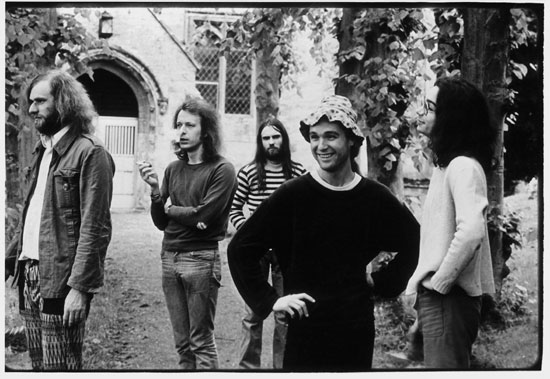
Faust was launched in 1971 by producer and music journalist Uwe Nettlebeck. With the goal of creating a band to work in Germany’s underground music scene, he assembled a group comprised of drummer Werner “Zappi” Diermaier, Hans Joachim Irmler (organ), bassist Jean-Hervé Péron, Rudolf Sosna (guitar and keyboards) and saxophonist/synthesist Gunther Wüsthoff. (Second drummer Arnulf Meifert appeared on the debut album and The Faust Tapes, but would not be present on Faust So Far nor Faust IV.)
The band’s Nettlebeck-produced self-titled debut from 1971 was a bracing and improvisational collection of avant garde stylings, sound collages and experimental sounds. Though highly influential and critically acclaimed, Faust was not a commercial blockbuster.
Mere months after releasing their debut, Faust was back in the studio, again with Nettlebeck, creating what would become their second LP, Faust So Far. The band’s sophomore release was a more conventional affair, but only by Faust standards: even to modern ears it’s still a wonderfully weird-sounding record.
Asked about the relative accessibility of Faust So Far as compared to the debut, both Péron and Diermaier decline to comment. But Irmler admitted that the change was intentional. “Of course,” he admits. “It was part of a consideration to make all the even-numbered albums ‘poppier,’ in our sense.” He says that the album aimed to present what he describes as a “Faustian feeling and interpretation of pop.”
Diermaier explains that Faust So Far was “constructed,” and credits Günther Wüsthoff for its concept. But he emphasizes that it was a group effort. “With Faust, conception and improvisation are connected through the different approaches of the musicians,” he says. “What was decisive was that there was no leader.”
Perhaps the closest Faust So Far came to what most listeners would consider pop was Sosna’s “It’s a Rainy Day, Sunshine Girl.” The track features a catchy melody wedded to a whooshing synthesizer sound and an insistent, monochromatic beat. Both of the latter qualities would be strongly associated with the sounds coming out of German bands Tangerine Dream and Neu! But Diermaier insists that Faust “had nothing to do with [those] other bands. Rudolf had the idea for ‘Rainy Day.’ He came into my room at night, woke me up, and said I should play drums to it. Then we went into the studio. I played along, and that’s how the piece came into being.”
Irmler emphasizes that the term krautrock hadn’t even been coined at the time. “We always felt somewhat outside of things,” he says. “Rock was something we ultimately couldn’t – and didn’t want to – serve.”
Péron says that even if krautrock existed at the time, he and his fellow musicians in Faust were unaware of any such movement. “Our studio, the Wümme School, was at the end of the world in a village with no more than 100 inhabitants,” he explains. “We had no ambition whatsoever to hear what was going on in the music world at the time.”
And while Faust’s music seems to exist in its own dimension, each member of the band had his own favorite artists. One might not detect the influences, but Irmler was a serious Beach Boys fan. Other members of Faust counted the Rolling Stones, Bob Dylan and Pierre Boulez among their favorites. Sosna and Diermaier both had an appreciation for the music of Frank Zappa. But Faust went its own way, and it’s perhaps only the music of last of those that bears any similarity to what they were doing.
“I’ve Got My Car and My TV” is vaguely reminiscent of the approach employed by Frank Zappa and the Mothers on We’re Only in it for the Money, and “Giggy Smile” from Faust IV suggests that Faust had an appreciation of the Mothers’ Flo & Eddie years, when former Turtles Howard Kaylan and Mark Volman fronted Zappa’s group. But the way Irmler addresses the topic doubles down on Faust’s musical Eurocentrism: “Of course,” he says. “The [music of the] Europe-influenced Zappa was a companion for some of us.”
To be continued…
About the Author

Bill Kopp
With a background in marketing and advertising, Bill Kopp got his professional start writing for Trouser Press. After a stint as Editor-in-chief for a national music magazine, Bill launched Musoscribe in 2009, and has published new content every business day since then (and every single day for several years). The more than 5000 interviews, essays, and reviews on Musoscribe reflect Bill's keen interest in American musical forms, most notably rock, jazz, and soul. His work features a special emphasis on reissues and vinyl. Bill's work also appears in many other outlets both online and in print. He regularly hosts lecture/discussions on artists and albums of historical importance (including monthly events Music to Your Ears and Music Movie Mondays), and is a frequent guest on music-focused radio programs and podcasts. In Spring 2023 he taught a history of Rock 'n' Roll at UNC Asheville's College for Seniors. He also researches and authors liner notes for album reissues -- some 40 to date -- and co-produced a reissue of jazz legend Julian "Cannonball" Adderley's final album. His first book, Reinventing Pink Floyd: From Syd Barrett to The Dark Side of the Moon was published by Rowman & Littlefield in 2018, and in paperback in 2019. His second book, Disturbing the Peace: 415 Records and the Rise of New Wave, was published in 2021 by HoZac Books. His third book, What's the Big Idea: 30 Great Concept Albums is available now. Read even more about him here.