
Dream Theater’s Third Act Commences with ‘Parasomnia’
With founding drummer back in the fold, progressive metal heroes return for 16th studio album
One of prog-metal’s most acclaimed groups has returned to its roots – and its most celebrated lineup – for a new album and tour. Dream Theater’s Parasomnia was released February 7, and the group’s 40th anniversary tour takes it to cities across the U.S.
Dream Theater began in 1985 and hit its stride when vocalist James LaBrie joined a few years later. The band’s second album, 1992’s Images and Words initiated a streak of briskly-selling and critically-acclaimed releases. The band’s fifth LP, 1999’s conceptually-based Metropolis Pt. 2: Scenes from a Memory marked the recorded debut of Dream Theater’s classic lineup: LaBrie plus guitarist John Petrucci, bassist John Myung, drummer Mike Portnoy and keyboardist Jordan Rudess.
That prolific and creatively fertile lineup would yield six studio albums and four live albums. Following the release of 2009’s Black Clouds & Silver Linings, Portnoy left the band; he would go on to take part in myriad other projects including the progressive supergroup Transatlantic.
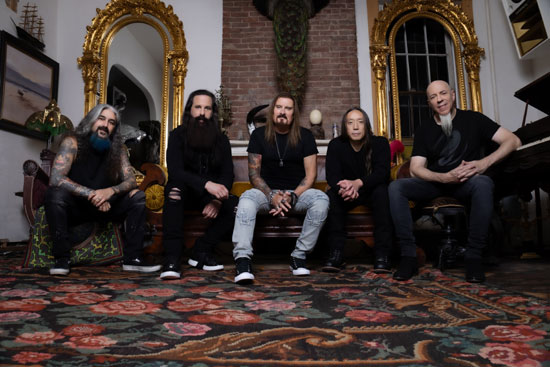
After more than 12 years away from the group he had co-founded, Portnoy rejoined Dream Theater in 2023. With the classic lineup back together, the band began work on its 16th studio album. Parasomnia’s loosely conceptual nature has been earning critical praise, and within days of release the album shot to the top spot on metal album charts.
Not that Dream Theater experienced a slump during its years without Portnoy, but the new album feels like a return to form. “One of the things that having Mike back in the band brought to us,” says Rudess, “was a love for elements we’ve had in our albums in the past: conceptual connections and repeating themes.” Rudess admits that those elements weren’t always readily obvious, “but the fans could find them if they looked hard enough.”
The simpatico that the five musicians had established back in the early 2000s made sessions for the new album go smoothly. “It all came together quickly as soon as we put our hands on our instruments,” Rudess says, noting that the album’s theme – the range of experiences humans encounter when suffering disruptive sleep disorders – “revealed itself very quickly in that process.”
Dream Theater’s trademark synthesis of power and subtlety – and of technical instrumental mastery applied to emotionally relatable song craft – is a product of the musical camaraderie among its members. For his part, Rudess – a Juilliard-trained musician, educator, software developer and winner of many best-keyboardist polls – revels in what he calls sonic discovery. “If I’m sitting in a room and all of a sudden somebody somehow – with whatever – makes an interesting sound, I go, ‘Wow, that was cool!’ And I’m always interested in asking, ‘How else can you make cool sounds?’”
Rudess brings that sense of wonder and adventure to his work with Dream Theater. “When I’m in the studio, I feel like I have a giant palette, almost like a painter,” he says. “I love the feeling of, ‘I’ve got every color here. All I have to do is dip my paintbrush into this one. Oh, and that’s cool. I’ll blend it with a little bit of this.’”
In Dream Theater, the traditional metal configuration of guitar-bass-drums-vocals is imbued with layers of nuance and power thanks to Rudess’ keyboard wizardry. “I get to be the orchestrator,” he says. “I get to be the choir. I get to be the piano and organ guy and the Clavinet guy. And I get to be special effects guy, and the spacey pads and weird sounds guy. That’s my world!”
Sound textures are only part of the equation; the coolest sound in the world amounts to little if it’s not combined with a strong melodic line. Dream Theater’s collaborative approach – all of the group’s music is credited to all five musicians – involves a great deal of give-and-take. “If [John Petrucci’s] guitars are playing some kind of chunky riff, I’m either going to double it or find a nice chordal thing to go over it so that I can shape the harmonics,” Rudess explains. He says that he and his band mates share a common goal when composing and arranging Dream Theater’s music: “We’re looking for something that feels really powerful; we want to feel the energy when we’re writing.”
Parasomnia’s opening track, “In the Arms of Morpehus” introduces several musical motifs. As the album unfolds, its thematic unity is reinforced by the strategic recurrence of those motifs. The connectivity of the songs is a kind of corollary to the re-establishment of Dream Theater’s classic lineup. “It’s incredible on so many levels to have Mike Portnoy back in the band,” Rudess says. “On one level it’s personal, because he and I have been friends ever since we met. But it’s also fantastic because of all the amazing [musical] things he brings, even beyond his beautiful drumming.”
Recording – and now heading out on tour – with the lineup that made many of Dream Theater’s most acclaimed records feels like a new beginning. “It’s like, ‘We’re back; we’re starting over again,’” Rudess says. “With all eyes on us for this next year [of touring], I think that will lead to whatever’s next for us. We just have to keep our eyes open and enjoy the flow.”
About the Author

Bill Kopp
With a background in marketing and advertising, Bill Kopp got his professional start writing for Trouser Press. After a stint as Editor-in-chief for a national music magazine, Bill launched Musoscribe in 2009, and has published new content every business day since then (and every single day for several years). The more than 5000 interviews, essays, and reviews on Musoscribe reflect Bill's keen interest in American musical forms, most notably rock, jazz, and soul. His work features a special emphasis on reissues and vinyl. Bill's work also appears in many other outlets both online and in print. He regularly hosts lecture/discussions on artists and albums of historical importance (including monthly events Music to Your Ears and Music Movie Mondays), and is a frequent guest on music-focused radio programs and podcasts. In Spring 2023 he taught a history of Rock 'n' Roll at UNC Asheville's College for Seniors. He also researches and authors liner notes for album reissues -- some 40 to date -- and co-produced a reissue of jazz legend Julian "Cannonball" Adderley's final album. His first book, Reinventing Pink Floyd: From Syd Barrett to The Dark Side of the Moon was published by Rowman & Littlefield in 2018, and in paperback in 2019. His second book, Disturbing the Peace: 415 Records and the Rise of New Wave, was published in 2021 by HoZac Books. His third book, What's the Big Idea: 30 Great Concept Albums is available now. Read even more about him here.