
A Chat with Mitch Woods
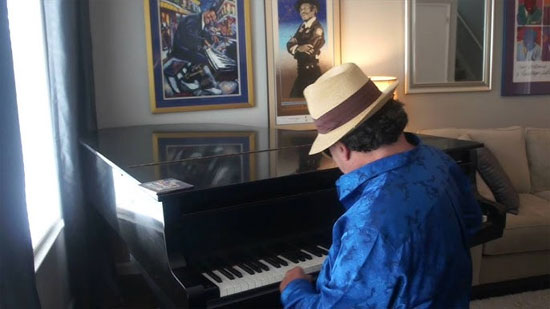
With his deep immersion into 20th century American musical styles, Mitch Woods is adept at channeling the sound and spirit of that music into his own winning original material. Woods’ latest album, Mitch Woods’ Happy Hour captures the feel of a live gig with his band the Rocket 88s. Woods chatted with me about how he fell in love with the music, and how he brings it alive for new audiences.
The prime era of jump blues and swing came and went before you were born. How and when did you discover it?
Well, first I got into boogie woogie; for me jump blues came later. I opened for Charlie Musselwhite; and I think it was his guitarist was High Tide Harris who said, “You sound like Louis Jordan!” And I was like, “Let me go find out who that is.” So I got all the Louis Jordan records, and I just loved his stuff. And that really led me into that whole era of music, which is my favorite. It’s the foundation of rock and roll, really, when the big bands were breaking into smaller units after the war. Guitar was just coming in, so you could have a six or five piece band that really jumped.
I love the humor in Louis Jordan’s songs; there’s so little of that anywhere [else]. I emulate that and write songs that have that humor. I have a song, Broke. It’s on the new album, but I wrote it awhile ago. It’s all about a guy wants to buy a gal a drink, and she orders the whole bar. It’s modeled after Louis Jordan’s Beware, Brother, Beware, and people love it. But I did have one night when a woman came up to me and said, “Don’t ever sing that song again!” Obviously, I never listened to her.
How did your early immersion in classical and jazz inform what you did when you moved into boogie woogie and other more modern styles?
When I started on piano, my mom was a single mom in Brooklyn, and she would hire the superintendent of the building to take me to school, to first and second grade. He was an African American man, and one time we stopped off at his cousin’s house, and I heard somebody playing boogie woogie piano. I said, “Wow! I’d like to do that!”
My mom married my stepdad, and he went out and got us a piano. They got me classical lessons, so for about three years, I studied classical. I was about 14 when I started to get bored with it. My [step]father said, “We got the piano; you’d better play.” So I asked, “How about if I get a teacher who can teach me jazz and popular music?”
I got this great teacher who was a bebop musician. And he taught me scales, riffs and chords – the bag of tricks you need to know to improvise. That got me going, and I just kept with it after that. And then, of course, we started bands. We didn’t have garages; we had basement bands.
When you started playing these styles of music in front of audiences, did people “get it” right from the start?
Yeah, I think people got it from the get-go. The thing is, when you hear this music, everybody loves it. It might not be the hip music of the time, but people love it. Swing dancers have become a big part of my audience. And at the very beginning, when swing was not even a thing, swing dancers would come down and dance to us. They became a big part of my audience.
Boogie Woogie Bar-B-Que makes me think of Boogie Woogie Blue Plate, Saturday Night Fish Fry and Beans and Cornbread. Was that intentional on your part?
Well, all that stuff inspires me. As I tell people at my shows, we sing about all the important things in life: food, booze, love and cars. Those are great American traditions; Chuck Berry was the master of that. We’ve begged and borrowed different riffs from some of those old songs, and I’ll add a bridge or something to make it my own.
What was your approach to recording the album at Kid Andersen’s Greaseland?
We did it all live in the studio; that’s always been my M.O. for this kind of music, really. You want to get that feel.
The Kid’s studio is interesting place. The grand piano’s in the kitchen, and the drums and the other guys are in another room. Kid’s sometimes in the control room playing guitar. When I first came in the studio, I thought, “This is… not going to be good.” But he’s such a whiz at getting great sounds, and it all came out great; it really captures that live feel. And that also has to do with the contribution of the musicians that I was working with in this iteration of the Rocket 88s.
With Happy Hour, were you trying to create the vibe of a live set?
Every album that I’ve done, I always want to pace it like a set. Maybe you start out really strong with some great jump stuff. Then I throw in a little New Orleans for a nice variety. And then maybe an early rock ‘n’ roll styled tune like Long, Lean and Lanky. And then a slow blues; you bring it all down again, and then you bring it back up. And that’s how I do a set.
But when I recorded them, I just wanted to record some of my best songs. And then after that was done, the process was to listen to it over and over again, and then make a set list that flows.
What’s next for you?
I concentrate on playing festivals around the world. I do the Legendary Rhythm and Blues Cruise; I started the piano bar on the ship, and I’ve been doing that for over 20 years.
I still want to do some more recording, too. Kenny Neal invited me to do some recording with him at his studio in Baton Rouge, so that might be my next recording project.
About the Author

Bill Kopp
With a background in marketing and advertising, Bill Kopp got his professional start writing for Trouser Press. After a stint as Editor-in-chief for a national music magazine, Bill launched Musoscribe in 2009, and has published new content every business day since then (and every single day for several years). The more than 5000 interviews, essays, and reviews on Musoscribe reflect Bill's keen interest in American musical forms, most notably rock, jazz, and soul. His work features a special emphasis on reissues and vinyl. Bill's work also appears in many other outlets both online and in print. He regularly hosts lecture/discussions on artists and albums of historical importance (including monthly events Music to Your Ears and Music Movie Mondays), and is a frequent guest on music-focused radio programs and podcasts. In Spring 2023 he taught a history of Rock 'n' Roll at UNC Asheville's College for Seniors. He also researches and authors liner notes for album reissues -- some 40 to date -- and co-produced a reissue of jazz legend Julian "Cannonball" Adderley's final album. His first book, Reinventing Pink Floyd: From Syd Barrett to The Dark Side of the Moon was published by Rowman & Littlefield in 2018, and in paperback in 2019. His second book, Disturbing the Peace: 415 Records and the Rise of New Wave, was published in 2021 by HoZac Books. His third book, What's the Big Idea: 30 Great Concept Albums is available now. Read even more about him here.