
Inuit Savants: The Residents’ ‘Eskimo’ (Part 2 of 2)
Continued from Part One…
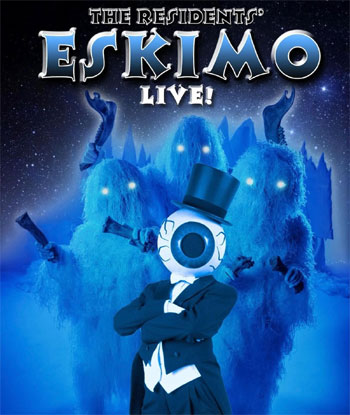 Bill: In ‘92, the group took another crack at developing a live touring opera of Eskimo. They went so far as to commission set designs from Ron Davis. Will any of those set designs figure into this tour?
Homer: Yeah, that was really a kind of a one-off deal that unfortunately never happened. They’re not really working with any of those ideas at this point.
Bill: When The Residents conceive of a live performance – whether it’s a one-off like A Night of Ideas or a tour – are things set in stone? Or do they do a postmortem after a performance and think, “Okay, how can we tinker with this and change it to improve it going forward?”
Homer: They certainly have tinkered with it and changed things from A Night of Ideas to Exoticon, and from Exoticon to now. But usually once they’re touring – once they have a show together – they don’t really change things a whole lot. If they did an American tour and then a European tour, things may get shifted around between that because you have a big gap of time. But when they’re doing 14, 15 shows in three weeks, they’re not changing things very much.
Bill: The Residents’ website currently lists only U.S. dates, but I understand that there will be an Eskimo tour of Europe, and one of Japan as well.
Homer: The shows in Japan have been booked; that’s happening. That will be at the Blue Note, which is a very fairly prestigious jazz supper club that they played before, about 10 years ago. And everyone’s looking forward to that.
The European [dates] are still being booked, which is why nothing has been announced yet. The Residents’ agent recently got a great offer for them to play Greece: Athens and Thessaloniki. So that will be happening, too.
Bill: Is there any chance at all for additional Eskimo dates in the U.S. at some point?
Homer: There’s been talk of a secondary U.S. tour, which would probably be fall/winter of 2026. But I think that everybody – agents, promoters, whatever – is looking to see how this one does. I’m expecting there probably will be [more U.S. dates], but nobody knows at this point.
Bill: Beyond the Eskimo tour dates, can you tell me anything about what The Residents have planned for the future?
Homer: They have done about 60 to 70 minutes of backing tracks for a new album. I’ve heard the music; I think it’s really interesting. Somewhere or other, one of them found a bunch of Balkan MIDI tracks, and it was like, “Well, what can we do with that?” And that became inspiration. Inspiration is only a jumping-off point, but it was an interesting jumping-off point.
Their last album, which came out earlier this year, is called Dr. Dark. It was based on an incident from the 1980s when two teenagers drank too much beer, took too much drugs, [listened to] too much heavy metal music, went off into a playground next door and… bam! There was a documentary film [Dream Deceivers] based on the trial of that, and one of The Residents saw it. And as it turned out, one of [the teenagers] only partially succeeded in blowing his head off. The filmmaker shot interview footage with this guy, and it’s a train wreck you cannot take your eyes off of.
Anyway, the point I’m trying to make is that the content for Dr. Dark originated there. It’s like it’s been there forever. Whereas with the new album, whatever it is, the inspiration came from these Balkan MIDI tracks. [The Residents] haven’t quite decided what they want to do with it in terms of content and lyrics yet, but they have some interesting ideas, and I’m sure that’s going to be pretty high on their priority list once they get past this initial tour.
Bill: I first interviewed Hardy Fox back in 2006, and I know that Jay Clem had done select interviews long before then. But at that time in ‘06, I was still surprised that a spokesman for The Residents and/or The Cryptic Corporation decided to do press. In recent years, you in particular have made yourself much more available to journalists; in fact this conversation is the third time I’ve interviewed you. And you’re even doing a meet-and-greet at the upcoming shows, which I found really surprising. What led to the change in the approach over the years, and does it represent any kind of a rethinking of the Theory of Obscurity?
Homer: It’s my own personal point of view that the media pretty much controls things. When somebody – Bush or whoever – was elected president 20 or 30 years ago, I was watching him give his acceptance speech, and there were shots of that. And basically what you had was this guy standing up there addressing a thousand cameras. He wasn’t talking to a group of people; he was talking to all these cameras. And I went, “Huh, okay. Well, that tells me where the real power is, ultimately.”
The Residents are deliberately obscure. They’ve been that way from the beginning; they like that. And in the beginning, that alone was enough to garner a certain level of publicity and interest. But after a while, when people like you don’t have anybody to talk to, it gets a little old. So Cryptic Corporation came up with the idea of spokespeople who then can interact with the media in a relatively straightforward way. And ultimately, that has worked.
Bill: The Residents have been working since the 1960s. At the start, did they have any goals or expectations with regard to how long they might continue operating?
Homer: This would seem like kind of a contradiction, I suppose, but The Residents have always been very ambitious; they saw things from a really long range, long-term point of view. And their point of view was that they were going to be there as long as it lasted. And it’s still going strong.
In many ways The Residents have become more spiritual than [before]. I’m not saying they’ve become religious, but the manifestation of them in a lot of ways is more spiritual than concrete. And given that, they feel like they can potentially go on forever. I may not be around long enough to see it, but that’s the attitude around here. We’ll see.
About the Author

Bill Kopp
With a background in marketing and advertising, Bill Kopp got his professional start writing for Trouser Press. After a stint as Editor-in-chief for a national music magazine, Bill launched Musoscribe in 2009, and has published new content every business day since then (and every single day for several years). The more than 5000 interviews, essays, and reviews on Musoscribe reflect Bill's keen interest in American musical forms, most notably rock, jazz, and soul. His work features a special emphasis on reissues and vinyl. Bill's work also appears in many other outlets both online and in print. He regularly hosts lecture/discussions on artists and albums of historical importance (including monthly events Music to Your Ears and Music Movie Mondays), and is a frequent guest on music-focused radio programs and podcasts. In Spring 2023 he taught a history of Rock 'n' Roll at UNC Asheville's College for Seniors. He also researches and authors liner notes for album reissues -- some 40 to date -- and co-produced a reissue of jazz legend Julian "Cannonball" Adderley's final album. His first book, Reinventing Pink Floyd: From Syd Barrett to The Dark Side of the Moon was published by Rowman & Littlefield in 2018, and in paperback in 2019. His second book, Disturbing the Peace: 415 Records and the Rise of New Wave, was published in 2021 by HoZac Books. His third book, What's the Big Idea: 30 Great Concept Albums is available now. Read even more about him here.