
The (Qo)Buz About High Quality Streaming Audio (Part 2 of 2)
Continued from Part One…
The Human Element
While some services cater to listeners interested in the latest pop single, Qobuz takes a more curated, intelligent view. “We’re very album-focused,” Mackta explains. “When you open up the app, it’s like walking into a record store.” He says that Qobuz has been designed with an old-school mindset. Whereas some services make use of admittedly sophisticated scientific algorithms to offer suggestions for listeners, Qobuz is built on a foundation of human curation. “Qobuz is intended for active music listeners,” he emphasizes. “People like you and me.”
Dan Mackta readily acknowledges that the advent of widespread music streaming brought with it some challenges. “And the amount of ‘music’ being delivered has grown exponentially in the age of artificial intelligence,” he says. He places quotes around “music” in this context for a good reason. “There’s a lot of… junk,” he admits. “There’s vacuum cleaner sounds and white noise, and 90% of it has only been listened to once, if that.” But because Qobuz employs actual human beings to curate its content, subscribers won’t have to wade through a sea of audio garbage. “You’ll never see that [stuff] on your home page; it’ll never be recommended to you,” he says. To find it, “you’d have to be looking for it,” he adds with a laugh. “Which you wouldn’t be.”
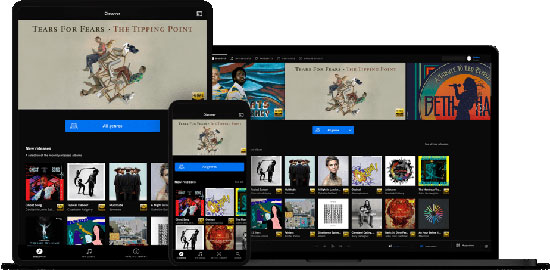
Because of its foundational emphasis on sound quality, Qobuz has attracted a subscriber base that values the same thing. “Genres like classical music, jazz and rock are big among that crowd,” Mackta says. He notes that mainstream artists like Billie Eilish and Fleetwood Mac are popular among the Qobuz listener base as well. “We have a very diverse group of music listeners,” he says. “We’ve got plenty of listeners who are streaming Chappell Roan all day, but [overall streams] are definitely skewed more toward music that isn’t on the current pop charts.”
Respect for Artists
One of the charges often leveled at streaming services is that their minuscule payouts fail to provide fair remuneration to the artists who made the music. Complicating the discussion is the fact that few streaming services release the actual figures, leaving the numbers open to speculation. What is known is that Spotify – one of the biggest players in the music streaming marketplace – is estimated to pay approximately $0.003 to $0.005 per stream. That works out to just over four dollars for 1,000 streams of a track.
Many streaming services offer a free subscription tier, supported by advertising. That kind of setup brings in much less revenue, and the associated costs are passed on to the paid subscribers. That leaves less money for artist payouts. Mackta concedes that Qobuz has been historically “a little bit more expensive” than some other streaming services, but notes that while Spotify and others have been raising their prices of late, Qobuz has largely held steady.
“So it’s not that our model is different,” Mackta says, “but our setup, our scale and our focus give us a much higher per-stream rate” to the artists. Qobuz is transparent in this regard. “We’re the only service that has announced our per-stream rate,” Mackta says. Audited figures released in 2025 showed that Qobuz paid an average per-stream rate of $0.018732 to rights holders – distributors, publishers and record labels – who then pay artists. Extrapolated to a theoretical 1000 streams, that represents about $18.73, more than 4.5 times what Spotify is estimated to pay. Mackta says that Qobuz’s status as a company that’s not publicly traded on stock exchanges allows that degree of openness, “because we don’t have to worry about every [public] statement affecting share price.”
Moreover, because Qobuz’s download store is a significant part of its business model, Mackta says that the company’s payout to artists is even higher than it would otherwise be. “The payout for digital downloads are closer to [those for] physical media in terms of the money flowing back to the artists,” he explains. “We believe that everybody benefits from [Qobuz offering] that option.”
The Future of Music Streaming
For music lovers, Qobuz’s model provides three strong advantages: an extraordinarily deep catalog, fair compensation to artists, and unparalleled audio quality for a superb listening experience. And Mackta says that all of that is just the beginning. With that in mind, innovation in line with its core principles points the way toward Qobuz’s future.
Mackta says that existing available technology has limited the quality of audio streamed over wireless headphones. “While it has gotten better in recent years, Bluetooth is always lossy,” he explains. But change is on the horizon. Mackta floats the idea of being able to walk around one’s home with wireless headphones, listen to high resolution streaming on Qobuz, and then walk outside and having a chip [in the headset] connect via Bluetooth with your phone so that the music continues to play – all seamlessly. “The technology doesn’t exist quite yet,” he cautions, “but the first wireless headphones should be coming to an electronics store near you by this Christmas. And we’re working on ways to make sure Qobuz is part of that.” Low-power wi-fi streaming is likely to be the latest game-changer in a constantly and rapidly evolving technology space.
Dan Mackta notes that the word is getting around about Qobuz. “In the last six months, the size of Qobuz’s paying audience has more than doubled,” he says, noting that the surge was driven by listener-led viral buzz on social media, not any sort of company-driven media campaign. “The challenge for Qobuz going forward,” he says, “is to keep making sure that we’re appealing to a lot of people while staying cool and quirky.”
About the Author

Bill Kopp
With a background in marketing and advertising, Bill Kopp got his professional start writing for Trouser Press. After a stint as Editor-in-chief for a national music magazine, Bill launched Musoscribe in 2009, and has published new content every business day since then (and every single day for several years). The more than 5000 interviews, essays, and reviews on Musoscribe reflect Bill's keen interest in American musical forms, most notably rock, jazz, and soul. His work features a special emphasis on reissues and vinyl. Bill's work also appears in many other outlets both online and in print. He regularly hosts lecture/discussions on artists and albums of historical importance (including monthly events Music to Your Ears and Music Movie Mondays), and is a frequent guest on music-focused radio programs and podcasts. In Spring 2023 he taught a history of Rock 'n' Roll at UNC Asheville's College for Seniors. He also researches and authors liner notes for album reissues -- some 40 to date -- and co-produced a reissue of jazz legend Julian "Cannonball" Adderley's final album. His first book, Reinventing Pink Floyd: From Syd Barrett to The Dark Side of the Moon was published by Rowman & Littlefield in 2018, and in paperback in 2019. His second book, Disturbing the Peace: 415 Records and the Rise of New Wave, was published in 2021 by HoZac Books. His third book, What's the Big Idea: 30 Great Concept Albums is available now. Read even more about him here.