
The Mind Movies of Adrian Younge
This feature appeared previously in SPIN Magazine.
Some artists combine genres as a stylistic challenge, motivated by curiosity: Can it even be done? But when Adrian Younge blends musical forms it comes from a much more authentic place, one born of deep study and understanding of those genres.
His latest release, the psychedelic soul opus Something About April III, is the culmination of — or at least the latest stop on — his fascinating musical odyssey.
Younge believes that as hip hop developed, its most skilled artists quickly achieved mastery of lyrics and arrangements. That yielded music that was “cool and interesting and different,” he says. “Hip hop sampled everything, pulled inspiration from everywhere to make something brand new.” But he suggests that hip hop never quite mastered music’s compositional side. “There’s always been a limitation, because hip hop has been so much based on samples.” Even with the cinematic, storytelling expertise of many hip hop artists, the genre could only be taken so far.
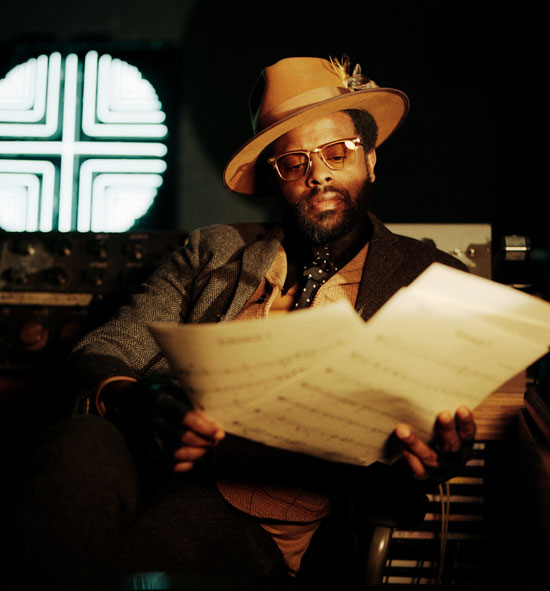
In his early years as a DJ and beat maker, Younge’s primary tool was an Akai MPC2000 sampler/sequencer workstation. Younge spent a lot of time immersed in listening sessions, scouring everything from Italian horror film soundtracks to classic funk, looking for irresistible sounds to sample. He says that in the process, he realized, “My beats aren’t as great as these records.”
Younge sought a way to build on — rather than plunder — the music that inspired him. “What I wanted to do, even before I even started playing instruments, was to continue the conversations of those records,” he says. “I would hear something by Ennio Morricone and say, ‘I need to study this music – the composition, the arrangement – so that I can try to create something [of my own].’”
Younge believed his vision required real instruments rather than samples. So the autodidact set about teaching himself to play all of those instruments himself. His first project along those lines was the Black Dynamite film soundtrack, released in 2009. Inspired by ‘70s blaxploitation flicks, the album showcased Younge playing guitar, bass, flute, organs, electric pianos, synthesizers, vibraphone, cello and saxophone. But he was just getting started. “I was still just doing a soundtrack,” he explains, “doing something that coincided with a movie.”
In 2011, Younge released Something About April. A fully-realized soundtrack for a film that didn’t exist, the album was Younge creating his own world. The album “represented my DJ crate,” he says. A look through Younge’s crate would find albums by Morricone, Portishead, Stereolab, Isaac Hayes, Wu-Tang Clan, and Curtis Mayfield. “And they’d all be in the same DJ set, because all of that music makes sense to me,” he explains. Something About April was Younge’s original creative expression of that wide-screen sensibility.
What happened next is ironic. “Everyone started sampling it,” Younge says with a smile. Jay-Z sampled “Sirens” on his own Magna Carta Holy Grail track “Picasso Baby.” The hip hop giant also sampled another Something About April track, “Reverie,” for his own “Heaven.” Other artists who sampled parts of Younge’s landmark album include Common, PHryme, Bilal and Talib Kweli.
While members of his band Venice Dawn played on the record, Younge says that “about 90% of the instrumentation” is him. Going forward, he continued to build upon his skills of writing, recording, engineering (in his all-analog Linear Labs studio) and musicianship. Younge returned to Something About April in 2016, crafting a second album of mind-movie music.
Between 2012 and 2023, he would be responsible — in whole or as a collaborator — for more than 50 albums. Co-leading The Midnight Hour with A Tribe Called Quest’s Ali Shaheed Muhammad, Younge toured to wide acclaim; in 2020 the duo launched their Jazz is Dead project, working with jazz legends like Roy Ayers, Gary Bartz, and Lonnie Liston Smith. Younge also created a concept album featuring Ghostface Killah (12 Reasons to Die) and scored music for Marvel’s Luke Cage. At present he has a dozen more albums completed but unreleased.
“I went from not knowing anything about music per se to learning how to read [music] and write for orchestra,” he says. For the final installment of his Something About April trilogy, Younge doubled down on his method of constant learning. “I’ve always wanted to play upright bass,” he says. “So I took some lessons.” That’s him on the bass fiddle all over Something About April III.
The third part of Younge’s SAA trilogy showcases Younge’s love for Brazilian music. In recent years he’s spent a lot of time in the South American nation, absorbing the culture and meeting many of the country’s musical icons. “I wanted to give something back,” he explains, “because Brazil has given the world so much musically. “With me digging so much into Brazilian psych records, I thought, ‘What would it be like to create a record that sounded like it came out in ‘71 or ‘72?’” With that in mind, Younge learned Portuguese (he now considers himself “semi-fluent”) and wrote all of the new album’s lyrics in the language. All of the vocal tracks were recorded in São Paulo with Brazilian singers.
Younge toured in support of the album in March and early April, leading a 10-piece orchestra. In mid-April he performed the entire trilogy in his hometown of Los Angeles, this time with a greatly expanded ensemble. A free outdoor concert in conjunction with Lincoln Center performance was announced for June 17, with additional dates to follow. “I say this humbly: I’ve never heard something like this before, ever,” he says. Emphasizing that he isn’t claiming Something About April III is necessarily better than everything else, Younge says that he’s breaking new ground by mixing his “quasi hip hop” sound with Brazilian textures. He likens the music to Ennio Morricone plus psychedelic soul plus “Pink Floyd with a 35-piece orchestra.”
The music of Adrian Younge has it both ways: sophisticated and street-level. “I like people to view my music as the highest of hi-fi, and the lowest of lo-fi,” he says. “I love both sides.”
About the Author

Bill Kopp
With a background in marketing and advertising, Bill Kopp got his professional start writing for Trouser Press. After a stint as Editor-in-chief for a national music magazine, Bill launched Musoscribe in 2009, and has published new content every business day since then (and every single day for several years). The more than 5000 interviews, essays, and reviews on Musoscribe reflect Bill's keen interest in American musical forms, most notably rock, jazz, and soul. His work features a special emphasis on reissues and vinyl. Bill's work also appears in many other outlets both online and in print. He regularly hosts lecture/discussions on artists and albums of historical importance (including monthly events Music to Your Ears and Music Movie Mondays), and is a frequent guest on music-focused radio programs and podcasts. In Spring 2023 he taught a history of Rock 'n' Roll at UNC Asheville's College for Seniors. He also researches and authors liner notes for album reissues -- some 40 to date -- and co-produced a reissue of jazz legend Julian "Cannonball" Adderley's final album. His first book, Reinventing Pink Floyd: From Syd Barrett to The Dark Side of the Moon was published by Rowman & Littlefield in 2018, and in paperback in 2019. His second book, Disturbing the Peace: 415 Records and the Rise of New Wave, was published in 2021 by HoZac Books. His third book, What's the Big Idea: 30 Great Concept Albums is available now. Read even more about him here.