
Album Review: Sendelica – The Complete Mankind
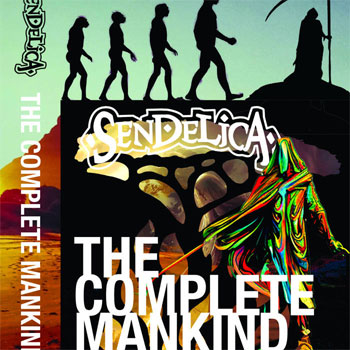 Here’s something different. A band most have never heard of, based in Wales, with shifting personnel built around two or three main players, and with an extensive catalog. They release a boxed set containing their four (yes, four!) most recent albums for the Fruits de Mer label. To that they add an additional panoply of extras, bonus cuts and outtakes It all adds up to eight(!) CDs (and eight-plus hours) of music. Let’s dig in.
And Man Created God
Listeners may find 2021’s And Man Created God to share the trancey vibe and character of early Porcupine Tree (in other words, the music under that banner made in the 1990s, when the “group” was Steven Wilson working on his own). The arrangements – soundscapes, really – are more organic than EDM, but a driving, hypnotic arrangement built around a single chord is the hallmark of the album. It’s immersive, inviting headphone music of the headiest kind. Vocal are buried in the mix, and for most part (except on “Sren Golwar”) are used as textural elements anyway. Nearly all of the tracks clock in well over the six-minute mark; three of them are more than 10 minutes long. But the tracks never overstay their welcome, offering up distinct textures that approach ambient but providing more interest. One solid riff or melody is enough for music of this style, as long as the musicians take that bit and explore it in various ways throughout the track’s runtime. This Sendelica does, and well.
The disc of bonus tracks from And Man Made God are interesting for those who wish to dig deeper, but some cuts don’t make (and weren’t intended to make) for an engaging listening experience. A sample title like “120 BPM Riff Idea One” should tell the uninitiated all they need to know. The alternate mixes of cuts like “Aeolian” and “MMT,” on the other hand, are as fascinating and sonically enveloping as their official counterparts.
One Man’s Man
A more sinister and foreboding aura pervades these tracks. The soundscape/ambient character remains, connecting One Man’s Man sonically to its predecessor, but there’s a “bigger” sound, and heavier riffage. Overall the album has a more organic feel. Some of that character may be down to the use of a real drum kit (And Man Created God used electronic drums to good effect). The saxophone bits are more prominent her, sparring with the Sabbath-y riffs. “Homo Rudolfensis” sounds very much like what one imagines Hawkwind playing the intro to Steppenwolf’s “Born to Be Wild” would sound. The grooves get deep and rubbery on “Homo Erectus,” and “Denisovans” takes listeners back to the approach of the previous record. And the ambient saxfest that is “Neanderthal” hearkens back to Pink Floyd’s The Endless River (or The Big Spliff if you insist).
The bonus tracks from One Man’s Man are nearly all demos; they make plain that the musical ideas that Peter Bingham and his band mates had were very fully formed by the time recording began. There’s a slightly less-polished (and more repetitive) feel to the tracks (as one would well expect) but as whole, they’re quite listenable. These tracks are unlikely to replace their official counterparts in listeners’ hearts and minds, but they are indeed good enough to stand on their own.
Man, Myth & Magic
That good ol’ Devil’s Triad forms the core of “Wheel of Fortune,” the opening of four lengthy tracks that make up Man, Myth & Magic. A doomy feel pervades the song, even while chirpy synth figures gurgle and bubble along its surface. The rest of the album floats by on a cloud, with varying textures that strike a perfect balance between ignore-it-ambient and fascinating trance-inducing music. Lee Relfe’s saxophone work reveals itself to be Sendelica’s secret weapon, playing the siren song that lures listeners to their… well, reverie, let’s say. Listeners who appreciate the stylistic nexus of Tangerine Dream and Ozric Tentacles will dig this in extremis.
The bonus disc for Man, Myth & Magic is much more raw, visceral and jagged. And in fact it’s a splendid companion for the main disc. As it takes a very different (and far more musically aggressive) approach to the musical ideas expressed on the album. It almost – but not quite – feels like a different (and angrier) band approaching the same material. Those who like their music ambient may find this disc too unsettling; the rest of will dig it.
Requiem for Mankind
On this album, Sendelica gets quite a bit more krautrocky, Dripping sounds and other keyboard textures paint a glacial picture. The saxophone imbues the music with a North African feel. It’s Sendelica at their most cinematic, creating an aural landscape that suggests a kind of calm desolation. The four tracks are all quite lengthy – in the 20-minute range – but never do they fail to offer compelling musical ideas. Compared to the earliest recording in this series, the drums are wonderfully expressive, taking their place as musical components rather than simply beat makers. Dissonance coexists peacefully with melody, and angular beats bump up against more conventional ones. It’s almost as if the entire suite of albums had been building toward this. Wordlessly, Sendelica create a sonic landscape that will draw listeners in and hold their attention. (Tip: A bit of booze or herb might hasten the journey.)
The final disc in the set features bonus material related to Requiem for Mankind. The first half of “Cosmic Slop (In the Beginning”) sounds very much like very early Tangerine Dream; the second half sounds like Steven Wilson’s early work. Two demos of “Let There Be Light” serve up more glacial, pastoral electronics. A demo of “Requiem for the Planet” features some lovely wordless vocals from Santtu Laako. And yes, said wordless vocals may remind listeners a bit of Clare Torry’s work on “The Great Gig in the Sky.” A demo for “Chaos” makes good on its title, with all manner of keening synths blogging to and fro. The disc – and the eight-CD set – concludes with an alternate mix of Requiem for Mankind’s title track. Any listener who has made it this far will enjoy the piece – full of Sendelica’s trademark grandeur and texture – just fine.
About the Author

Bill Kopp
With a background in marketing and advertising, Bill Kopp got his professional start writing for Trouser Press. After a stint as Editor-in-chief for a national music magazine, Bill launched Musoscribe in 2009, and has published new content every business day since then (and every single day for several years). The more than 5000 interviews, essays, and reviews on Musoscribe reflect Bill's keen interest in American musical forms, most notably rock, jazz, and soul. His work features a special emphasis on reissues and vinyl. Bill's work also appears in many other outlets both online and in print. He regularly hosts lecture/discussions on artists and albums of historical importance (including monthly events Music to Your Ears and Music Movie Mondays), and is a frequent guest on music-focused radio programs and podcasts. In Spring 2023 he taught a history of Rock 'n' Roll at UNC Asheville's College for Seniors. He also researches and authors liner notes for album reissues -- some 40 to date -- and co-produced a reissue of jazz legend Julian "Cannonball" Adderley's final album. His first book, Reinventing Pink Floyd: From Syd Barrett to The Dark Side of the Moon was published by Rowman & Littlefield in 2018, and in paperback in 2019. His second book, Disturbing the Peace: 415 Records and the Rise of New Wave, was published in 2021 by HoZac Books. His third book, What's the Big Idea: 30 Great Concept Albums is available now. Read even more about him here.