
Dirty Logic: Reelin’ in the Classics
The recent interest in so-called “yacht rock” – brought about thanks to a new HBO documentary on the subject – has brought the names of several bands from the ‘70s back into the public consciousness. One of the acts mentioned in the film is Steely Dan, the three-time Grammy Award winning group. But in the minds of some of Western North Carolina’s top musicians, the appeal of Steely Dan’s music has never waned. Nearly a dozen of those WNC players and singers came together as Dirty Logic, a tribute to the idiosyncratic and unconventional group.
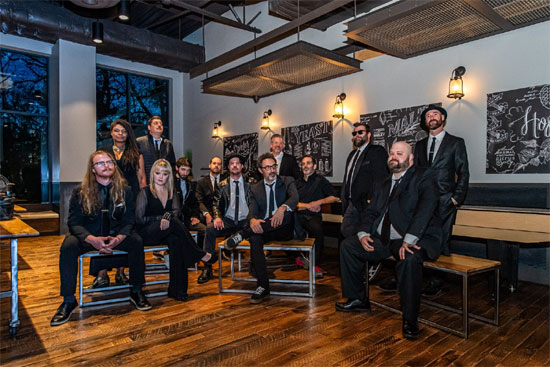
Like all of the musicians who would eventually join Dirty Logic, Patrick Armitage is a busy, in-demand musician who has been involved in many high-profile musical projects in and around Asheville. In 2018, the former drummer for the Jon Stickley Trio was part of a one-off “pickup gig” in Asheville. During discussions after their set, one of the musicians asked Armitage what his dream project would be. “What I’ve always wanted to do,” he replied, “is put together a Steely Dan tribute.”
Steely Dan came together in Upstate New York in 1971 when two studio musicians, Walter Becker and Donald Fagen, decided to do something more interesting and challenging than their previous gigs. While the earliest Steely Dan lineup was a proper band, by the mid 1970s Becker and Fagen retreated to the studio and worked with carefully-selected musicians chosen for what they could bring to each track.
Between 1972 and 1980, Steely Dan released seven studio albums, six of which would go Platinum (one million copies sold) or better. Though of more an an “album band” than a purveyor of singles, Steely Dan nonetheless landed ten of its 18 singles of that era on the U.S. Top 40 charts. Songs like “Do it Again,” “Reelin’ in the Years,” “Rikki Don’t Lose that Number,” “Peg, “Deacon Blues” and “Hey Nineteen” are among the many Steely Dan classics.
Those and other songs in the group’s catalog are catchy and memorable. Ask any serious musician and they’ll tell you something else that characterizes Steely Dan songs: they’re not easy to play. The arrangements are complex, and the jazz-tinged (and sometimes just plain jazz) compositions require serious skill and commitment.
If Armitage’s dream were ever to become a reality, he’d have to aim high. “I knew that I had to get some of the best session [musicians] in town,” he recalls, “and that it would be hard to put something like that together and get people to commit.” But when he made the decision to move forward and started making calls, he found the musicians he needed. One week after that fateful post-gig conversation, Dirty Logic held its first rehearsal.
“We set a super-high standard,” he says. “We rehearsed every week.” Five months later, the new group played its first show, at the now-shuttered Isis Music Hall in West Asheville. “That show sold out,” Armitage says with pride. “We knew right there: ‘Okay, this is really a thing.’”
Inevitably, there would be some turnover in the group’s lineup. But overall, Dirty Logic has remained remarkably stable since its early days. Bassist Jake Wolf joined a few months after the group’s launch; then as now he’s impressed by the caliber of musicianship within the band. “Everyone is really good at walking that tightrope: having deep respect for the music as it was written and recorded, and doing the thing authentically while still being themselves,” he says.
Armitage notes that because of the demands of such a large ensemble – typically 11 people onstage – when a show is booked, each and every musician has a replacement lined up. “Every person in this band has at least two people that they can call on if they can’t do a gig,” Armitage says.
Because of the many commitments the band members have, Dirty Logic plays an average of only eight shows each year. The farthest the large ensemble has traveled for a show was a “crazy festival” in Alabama. (“We all got food poisoning,” Armitage recalls with a pained laugh.) In general the group books shows within a few hours’ drive from Asheville.
Against that backdrop, hometown shows for Dirty Logic are a rare event. The recent performance at the Wortham Center was the group’s first local gig since an early September show at Salvage Station shortly before the venue fell victim to flooding from Tropical Storm Helene. Wolf says that in the aftermath of the devastation to the region, the show felt “like a homecoming. These shared experiences – to be performing and to be in the audience – feel really meaningful,” he says.
For that show, the group – which Wolf estimates has at least 50% of Steely Dan’s music in its current repertoire – played two albums in their entirety. The program featured hardcore fan favorite The Royal Scam (released in 1976) and the 1977 blockbuster album Aja.
Wolf says that while The Royal Scam isn’t the most well-known Steely Dan album, “from a musician’s standpoint, it’s a big, big album. It signaled a departure from what they had been doing, and toward jazz-rock.” Aja is immersed in a jazz vibe as well, and it holds the distinction of being Steely Dan’s biggest selling record. “Playing Aja shows the true versatility and the essence of why we wanted to do this band,” Armitage says.
The Dirty Logic performance in January also featured a selection of popular hits from other Steely Dan records. Emphasizing that the group enjoys all of the songs in its deep repertoire, Armitage chuckles and says, “You kind of have to play [the hits] … If you play a bunch of b-sides, maybe they’re not going to come see you again.”
On the subject of that yacht rock, neither Wolf nor Armitage is on board with describing Steely Dan with that label. “They have some hits that coincide with that movement,” Wolf allows. “But I always think of Steely Dan as a bunch of jazz prodigies playing pop music.”
About the Author

Bill Kopp
With a background in marketing and advertising, Bill Kopp got his professional start writing for Trouser Press. After a stint as Editor-in-chief for a national music magazine, Bill launched Musoscribe in 2009, and has published new content every business day since then (and every single day for several years). The more than 5000 interviews, essays, and reviews on Musoscribe reflect Bill's keen interest in American musical forms, most notably rock, jazz, and soul. His work features a special emphasis on reissues and vinyl. Bill's work also appears in many other outlets both online and in print. He regularly hosts lecture/discussions on artists and albums of historical importance (including monthly events Music to Your Ears and Music Movie Mondays), and is a frequent guest on music-focused radio programs and podcasts. In Spring 2023 he taught a history of Rock 'n' Roll at UNC Asheville's College for Seniors. He also researches and authors liner notes for album reissues -- some 40 to date -- and co-produced a reissue of jazz legend Julian "Cannonball" Adderley's final album. His first book, Reinventing Pink Floyd: From Syd Barrett to The Dark Side of the Moon was published by Rowman & Littlefield in 2018, and in paperback in 2019. His second book, Disturbing the Peace: 415 Records and the Rise of New Wave, was published in 2021 by HoZac Books. His third book, What's the Big Idea: 30 Great Concept Albums is available now. Read even more about him here.