
Album Review: David Gilmour — Luck and Strange
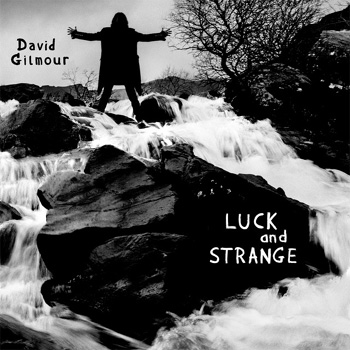 Releasing his first studio album in nearly nine years, guitarist David Gilmour continues his creatively fruitful journey beyond Pink Floyd. While Gilmour made his name as a member of that group – effectively replacing founder Syd Barrett in 1968 and remaining to its end – he has always had more to offer musically than what could fit within the confines of that group.
A musician’s musician, Gilmour is best known for his signature lead guitar work, mellifluous vocals and a dedicated work ethic. Though Gilmour is a gifted songwriter, in recent years his wife, novelist/journalist Polly Samson has taken on the role of primary lyricist. And that move has helped to set Gilmour’s music apart from the body of work he helped create with Pink Floyd.
As a solo artist, Gilmour has not been prolific; in the years since his self-titled debut in 1978, he has released only four studio albums and two live sets. Instead, he values quality over quantity, releasing an album only when it suits him. His newest, Luck and Strange is a finely-crafted album that manages a tricky feat: it serves up songs that should satisfy listeners who cherish his “Floydian” approach to songcraft, while elsewhere moving boldly beyond the borders of that style to explore other musical landscapes.
In some ways, Luck and Strange is a family album, making intelligent use of the creative energies of Gilmour’s relations. Samson’s lyrics are emotionally resonant, yet with a character completely different than the acerbic, sometimes cynical lyricism of Gilmour’s long-estranged Pink Floyd band mate Roger Waters. As befits an album made in part the lockdown era, Samson’s lyrics deal with themes of mortality and the great unknown. “The Piper’s Call” speaks of the empty promise of eternal youth. And the title track reflects upon the metaphorical final curtain. Yet there’s a contemplative warmth that pervades all of the lyrics, and Luck and Strange is all the richer for it.
Many years ago, Gilmour’s and Samson’s son Joe was recorded as he implored his dad to sing. Captured and preserved on the medium of that time – a Minidisc – Joe’s vocal is subtly featured in “Sings.” Son Charlie is co-credited for some of the lyrics on the lush and deeply textured “Scattered.” Another son, Gabriel Gilmour provides backing vocals on two tracks.
But the family contribution that’s getting the most attention is also the most remarkable: 22-year-old Romany Gilmour provides harp and an evocative, soul-stirring lead vocal on “Between Two Points.” A cover of a little-known 1999 tune from the Montgolfier Brothers, Gilmour’s reading of “Between Two Points” is more than a fine song with a guest vocal. Thanks to Romany’s performance, it’s a true collaboration
The album makes extensive use of orchestration – strings, chorus and more – giving it a wide-screen feel. The bluesy “Dark and Velvet Nights” is smoldering, sinister and catchy. A pair of instrumentals, “Black Cat” and “Vita Brevis” explore subtle and ethereal sonic spaces. Listeners who want more of Gilmour’s classic soaring guitar work will luxuriate in Luck and Strange, especially during the second half of “Between Two Points.”
But at its core, David Gilmour’s fifth studio album is about much more than all that. It’s a fully-realized artistic statement from an artist who has nothing left to prove, but who – at age 78 – is nevertheless crafting some of the best music of his lifetime.
About the Author

Bill Kopp
With a background in marketing and advertising, Bill Kopp got his professional start writing for Trouser Press. After a stint as Editor-in-chief for a national music magazine, Bill launched Musoscribe in 2009, and has published new content every business day since then (and every single day for several years). The more than 5000 interviews, essays, and reviews on Musoscribe reflect Bill's keen interest in American musical forms, most notably rock, jazz, and soul. His work features a special emphasis on reissues and vinyl. Bill's work also appears in many other outlets both online and in print. He regularly hosts lecture/discussions on artists and albums of historical importance (including monthly events Music to Your Ears and Music Movie Mondays), and is a frequent guest on music-focused radio programs and podcasts. In Spring 2023 he taught a history of Rock 'n' Roll at UNC Asheville's College for Seniors. He also researches and authors liner notes for album reissues -- some 40 to date -- and co-produced a reissue of jazz legend Julian "Cannonball" Adderley's final album. His first book, Reinventing Pink Floyd: From Syd Barrett to The Dark Side of the Moon was published by Rowman & Littlefield in 2018, and in paperback in 2019. His second book, Disturbing the Peace: 415 Records and the Rise of New Wave, was published in 2021 by HoZac Books. His third book, What's the Big Idea: 30 Great Concept Albums is available now. Read even more about him here.