
Book Review: Listening to Prestige
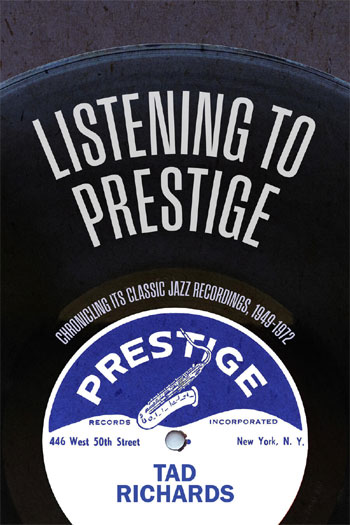 One potential function of a book-length treatment of a subject is as a springboard to initiate a wider discussion. In the hands of a skilled writer, a book about a very specific topic – let’s say the catalog of Prestige Records, to pick a not-exactly-random example – can serve as an opportunity to highlight (or even dig deeply into) the work of artists who recorded for that label.
And that is part of what Tad Richards does with his wonderful Listening to Prestige. On one level, it’s an appreciation – a love letter, if you will – of Bob Weinstock’s influential independent record label. But simultaneously, Listening to Prestige provides a canvas upon which Richards places the work of many – not quite all, but close – of the era’s jazz artists into a larger context.
Listening to Prestige is neatly divided into chapters covering the recordings and artists associated with the label during its 1949-72 heyday. And within each chapter are sidebars – sometimes lengthy, sometimes brief – in which Richards takes a more personal look at specific records. (Hence the “Listening to…” of the book’s title.) Readers largely unfamiliar with the jazz canon of the era may initially find themselves slightly overwhelmed by the sheer volume of names therein, but Richards’ clear, concise and accessible writing style all but guarantees that those readers will nonetheless be drawn in by his work.
Along with providing context that helps elucidate the work that those artists did for Prestige – whether it’s a big name like Miles Davis, Sonny Rollins or John Coltrane, or a relative obscurity like vibraphonist Dave Pike (a favorite of mine, by the way) – Richards helps the reader understand why what they did is worth a listen. And because the collaborative nature of that era’s jazz meant that pretty much everyone of note seemed to work with everyone else at least one time, he weaves together the artists’ stories in a way that makes as much sense as it can.
For those interested but relatively unschooled in jazz (this writer among that class of listeners), Listening to Prestige is a valuable resource, and a fine read. I suspect, too, that for those far more well-versed in the intricacies of jazz, Listening to Prestige will prove a most worthwhile read as well. Recommended.
NOTE: The book can also serve as a fine companion to another recent title, WAIL: The Visual Language of Prestige (not to mention, of course, any of the records released on the label).
About the Author

Bill Kopp
With a background in marketing and advertising, Bill Kopp got his professional start writing for Trouser Press. After a stint as Editor-in-chief for a national music magazine, Bill launched Musoscribe in 2009, and has published new content every business day since then (and every single day for several years). The more than 5000 interviews, essays, and reviews on Musoscribe reflect Bill's keen interest in American musical forms, most notably rock, jazz, and soul. His work features a special emphasis on reissues and vinyl. Bill's work also appears in many other outlets both online and in print. He regularly hosts lecture/discussions on artists and albums of historical importance (including monthly events Music to Your Ears and Music Movie Mondays), and is a frequent guest on music-focused radio programs and podcasts. In Spring 2023 he taught a history of Rock 'n' Roll at UNC Asheville's College for Seniors. He also researches and authors liner notes for album reissues -- some 40 to date -- and co-produced a reissue of jazz legend Julian "Cannonball" Adderley's final album. His first book, Reinventing Pink Floyd: From Syd Barrett to The Dark Side of the Moon was published by Rowman & Littlefield in 2018, and in paperback in 2019. His second book, Disturbing the Peace: 415 Records and the Rise of New Wave, was published in 2021 by HoZac Books. His third book, What's the Big Idea: 30 Great Concept Albums is available now. Read even more about him here.