
A Conversation with Waitiki 7’s Randy Wong (Part 2 of 2)
 Continued from Part One…
From my perspective as a listener, exotica is a quintessentially American form because it plunders from a lot of different things. And what could be more American than that, really?
Oh, yeah. It came out of the post World War II travel phenomenon. And everyone wanted to escape. Everyone wanted a fantasy. And it’s therefore fitting. Some people want to travel to the Pacific, others want to travel to the Caribbean. Why can’t those two ideas come together in a creative way? The music isn’t indigenous to any particular single genre or country. But maybe it’s indigenous to the escapist construct in our in our minds. Everyone needs an escape. Especially now.
How do you navigate the line between the serious treatment of the form and what some people would call the kitsch element of it?
Well, I think kitsch is a judgment call. You never know what’s going to be a random fact to someone else. We all come from different spaces in different times. What one person’s going to judge is, “I like this song; I don’t like that song. That’s good music, that’s bad music. That’s kitsch, that’s not kitsch.” It’s hard to know what people will think.
I like to think that it comes down to your artistic intention and how you represent yourself. I’ve learned over the last 20 years that we’ve been doing this music that the bird calls that were done in the original recordings, they all have a certain time and place. They sound random, but they aren’t. There’s actually particular calls that they’re doing for particular songs, so there’s a performance practice to it. Lopaka is he’s recreating his father’s bird and animal calls, and he’s doing it vocally, often without fingers in his mouth, because he’s playing percussion at exactly the same time.
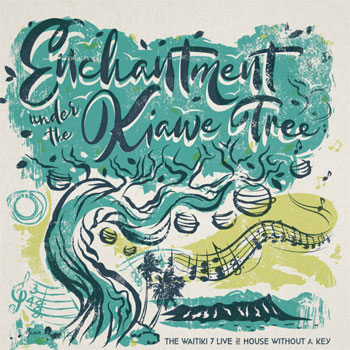
Why not one, but two new albums in 2025?
We have this residency at the Halekulani, which is an exquisite luxury hotel. Part of their belief and strategy is “Everything for the arts.” They support a lot of arts organizations: the Hawaii Symphony, the Hawaii Youth Symphony, the ballet, et cetera. When they invited us to bring exotica back to Waikiki, they became our home. And so then I started thinking, “If we’re going to be performing live, we might as well also go into the studio right after the shows are done.” And the original idea was to release the two albums – a live album and a studio album – only on vinyl. Because vinyl is where the collectors are. And that’s where people who love Exotica are; they’re huge record collectors.
And then as were going through that process, I started hearing about people who are now only buying music on CD! And then I was talking to other friends, and they said, “Kids these days are very into physical media; all these high school kids are also buying CD players. You know, maybe it’s a harder sell to convince your parents to buy you a record player, but somehow you can convince them to buy a CD player. So we were like, “Okay, we’ll put the two albums on CD, too.”
It’s an appropriate milestone and documentation of how far the band has come, and to experience this exotica sound not just in a studio session, but also live. Because that’s the one thing that we don’t have a lot of as collectors and as historians of the music: What do those bands sound like when they’re performing live?
We do see it sometimes. There was a Martin Denny reissue that had a couple of live tracks. There’s his Live in Japan album from the ‘90s – shortly before he passed – but it doesn’t really capture what the show was like back in the ‘50s. The music had passed, had become cliché. You can watch old clips of the Ed Sullivan show and see Arthur Lyman; just briefly, though. So we thought a live album would be apropos.
After all these years, what do you think explains the enduring appeal of exotica?
I think exotica has something for everyone. The original songs tend to be really short; they’re kind of like character pieces. I liken them to when you go and watch Tchaikovsky’s Nutcracker: each short dance is two or three minutes, and you really get the character of it. You get into this zone: “We’ve got Ports of Paradise, and then the next one we’ve got…” They’re like audio travelogues.
And when they improvise, it’s in relation to this character they’ve already built up. So it’s not like you’re sitting down and you’re listening to like a 25 minute Coltrane Live in Paris with a free jazz solo. That’s a commitment that’s inaccessible to a lot of people. But exotica is instrumental, right? You can have it on in the background. You can have it as a conversation piece. And there’s aspects that are both classical and jazz.
We have people that frequently come out to the shows who will say, “I have exotica records, but I’ve never heard it live. I also never go and see jazz in a club. I never go out and see chamber music in a museum or something. But I loved your show.” And to me, that really speaks volumes to how music is a great connector. I recall I none of your interviews, an artist said that “Music is the great unknown architecture that connects the universe.” And that quote really resonated with me, because even if you don’t know what exotica music is, or you don’t know that the genre has a name, it does connect us.
You may also enjoy my interview with Tikiyaki Orchestra’s Jim Bacchi.
About the Author

Bill Kopp
With a background in marketing and advertising, Bill Kopp got his professional start writing for Trouser Press. After a stint as Editor-in-chief for a national music magazine, Bill launched Musoscribe in 2009, and has published new content every business day since then (and every single day for several years). The more than 5000 interviews, essays, and reviews on Musoscribe reflect Bill's keen interest in American musical forms, most notably rock, jazz, and soul. His work features a special emphasis on reissues and vinyl. Bill's work also appears in many other outlets both online and in print. He regularly hosts lecture/discussions on artists and albums of historical importance (including monthly events Music to Your Ears and Music Movie Mondays), and is a frequent guest on music-focused radio programs and podcasts. In Spring 2023 he taught a history of Rock 'n' Roll at UNC Asheville's College for Seniors. He also researches and authors liner notes for album reissues -- some 40 to date -- and co-produced a reissue of jazz legend Julian "Cannonball" Adderley's final album. His first book, Reinventing Pink Floyd: From Syd Barrett to The Dark Side of the Moon was published by Rowman & Littlefield in 2018, and in paperback in 2019. His second book, Disturbing the Peace: 415 Records and the Rise of New Wave, was published in 2021 by HoZac Books. His third book, What's the Big Idea: 30 Great Concept Albums is available now. Read even more about him here.