
Rainbow Redux: A Lost Classic Returns (Part 1 of 2)
A portion of this feature appeared previously on The Tonearm.
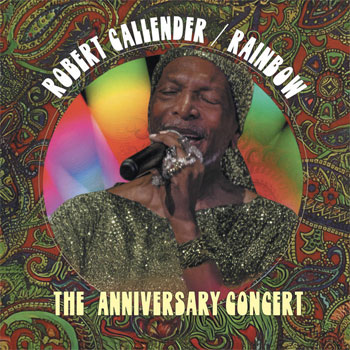 The late 1960s brought an anything-goes approach to art and popular culture. Creative concepts that would have seemed ludicrous even a year or two earlier were now given serious consideration. That meant that recording artists could explore some of their most ambitious – and often resolutely noncommercial – ideas, and those projects could actually see the light of day.
One such project was Rainbow, the debut album from Robert Callender. Just a few years before, he was r&b/pop singer Bobby Callender, cutting songs like “Little Star,” a regional hit single on Morris Levy’s Roulette Records. But by 1968, the singer-poet-musician had set his sights much higher. With its fusion of jazz, psychedelia, spoken word and exotic Eastern textures, Rainbow would be the beginning of a creatively fertile path for Callender. Though the album met with little commercial success, its legacy has endured.
And while Callender himself seemed to have disappeared from the music scene, he continued to work. A few years ago, he brought the second of his three albums to the concert stage for the first time. That event led to an association with archivist, author and hardcore music collector Chaim Obrien-Blumenthal. Now, Think Like a Key Music has released a CD+ DVD of a special 2023 performance of Rainbow. That project looks to be the start of a late-stage renaissance in the career of Robert Callender.
Obrien-Blumenthal’s connection with Callender began with a feature written for Shindig! Magazine. That eventually led to Obrien-Blumenthal co-producing Rainbow: The Anniversary Concert. He also authored the release’s liner notes. He spoke with me to provide background and context on the whole project, how it came about, and where it’s headed.
Bill Kopp: When did you first discover Robert Callender and Rainbow?
Chaim Obrien-Blumenthal: I’m a major record collector, and I imagine I came across the album in a record shop somewhere. Possibly I had read about it in a vintage trade magazine or a review. It’s one of those records that the minute you see the cover, you’re like, “What is this?” I’m the kind of guy who looks at a record and makes connections: who produced it, and who’s credited. And I was like, “Okay, now I’m even more intrigued.” And then when you hear it [you realize], “This doesn’t sound like anything [else], even from that era.” It’s totally in a sphere by itself.
That was the tough part when were trying to promote this. I hate making comparisons, but I was like, “Over the years, people have compared him to Scott Walker.” But really, nothing sounds like it. Rainbow is the first of his albums, but each is unique.
Funny enough, I was more familiar early on with his singles. He had a pretty big hit in the early ‘60s on the East Coast with a song called “Little Star.” So that 45 you’d see all around. And then I found some of his other singles, which was another challenge because [they’re on] small labels. Granted, they don’t sound anything like Rainbow. But he was writing his own songs, and there’s kind of a germ there, the beginning of something.
Was it a challenge to locate him for the Shindig! story?
I forget the exact timeline, because I’ve tracked down hundreds of artists over the years. I found out he was doing a show in Orlando; he was performing the second album [1972’s The Way (First Book of Experiences)]. I got in touch with the venue he was performing at, and they got me in touch with him.
And it was really funny – he reminded me of this recently – he wasn’t seeking any publicity at all for this event. I reached out to him, and he was amazed: “Somebody wants to interview me?” I don’t know if he’d ever heard of Shindig! or anything. It was one of the musicians he worked with who convinced him: “You should do the interview. Why not?” We ended up talking, and that led to a friendship.
One of your goals with the Shindig! feature was to try to correct some misconceptions about Callender. What were the primary misconceptions?
There was a producer of, I believe it was, his third album. A gentleman who owned a studio in New England where Robert recorded in the ‘70s. He wrote up this whole piece online, and it’s really fascinating to read. He talks about this caravan of people coming to a studio, dropping rose petals behind Robert everywhere he walked. He had this entourage with him, and he only spoke in French; he refused to speak in English to anybody. So that was what most people knew about Robert.
And then at the end of the piece the producer basically says, “Robert said, ‘This is just thing I’m doing; I’m cashing in on the trends.’” But people have agendas. They were more industry players, coming from a different generation [an older generation, before the sixties rock explosion happened and psychedelia came in]. They were coming from a perspective where they were basically all business. So there was a lot of this misconception, [plus] the fact that nobody really knew anything about him. And it wasn’t the kind of thing where you could [refer] to an interview with another artist [who could say], “I hung out with him.” There was nothing to base it on. There was [just] that one piece online, and that was it. These rumors spread and then they became “truth,” unfortunately.
I’m an archivist, so I’ve gone through all the trade magazines from back in the day. And there’s not a lot there [about Callender]. So when I first had the chance to speak with Robert, he was gracious, fascinating, and had amazing stories. There was no ego there whatsoever. Obviously he was happy to tell his stories, but none of this “I’ve told these stories 20 times.”
Robert [had been] working behind the scenes for Murray the K. [In most written accounts] Murray was “the guy,” so everything is [about him]. You don’t see a lot of Robert. And that became more an issue later when we had to look for photos for the article; there were so few. And Robert didn’t have anything he could provide. So it was down to my archival skills, trying to track things down.
When we did the reissue, besides coming up with the project and writing the liner notes, I also supplied a lot of the trade clippings. We still don’t know what MGM [Records]’s publicity campaign was at the time; it’s a little sketchy. I’ve never seen a press kit for the original album. We’ve never seen a single press photo from when the album came out.
Robert’s a lovely guy who is very dedicated to his art and to his music. And he’s very motivated to put his music and his thoughts out there. Chatting with him that first time for Shindig!, any myths I’d heard were debunked right away. It was an absolute pleasure and enlightening to hear his stories. And for the record, he did not insist nor require I speak French to him; none of that!
About the Author

Bill Kopp
With a background in marketing and advertising, Bill Kopp got his professional start writing for Trouser Press. After a stint as Editor-in-chief for a national music magazine, Bill launched Musoscribe in 2009, and has published new content every business day since then (and every single day for several years). The more than 5000 interviews, essays, and reviews on Musoscribe reflect Bill's keen interest in American musical forms, most notably rock, jazz, and soul. His work features a special emphasis on reissues and vinyl. Bill's work also appears in many other outlets both online and in print. He regularly hosts lecture/discussions on artists and albums of historical importance (including monthly events Music to Your Ears and Music Movie Mondays), and is a frequent guest on music-focused radio programs and podcasts. In Spring 2023 he taught a history of Rock 'n' Roll at UNC Asheville's College for Seniors. He also researches and authors liner notes for album reissues -- some 40 to date -- and co-produced a reissue of jazz legend Julian "Cannonball" Adderley's final album. His first book, Reinventing Pink Floyd: From Syd Barrett to The Dark Side of the Moon was published by Rowman & Littlefield in 2018, and in paperback in 2019. His second book, Disturbing the Peace: 415 Records and the Rise of New Wave, was published in 2021 by HoZac Books. His third book, What's the Big Idea: 30 Great Concept Albums is available now. Read even more about him here.