
Asheville’s Hellbender: After the Flood, Music
This feature was originally published in Mountain Xpress ahead of the new concert venue’s July 17 opening. — bk
According to environmental scientists, the presence of the Hellbender – an aquatic salamander endemic to the Appalachian region – is a strong indicator of good water quality. And the opening of Hellbender – an outdoor concert venue in a part of Asheville severely damaged by Tropical Storm Helene – promises to aid in the continued revitalization of the region’s live concert scene. Hellbender kicked off its opening season with a July 17 double bill featuring Band of Horses and Dinosaur Jr.
A Trio of Setbacks
Among the local areas hit hardest by Helene were properties on and near the banks of the Swannanoa and French Broad Rivers. Located on Thompson Street mere yards from the Swannanoa, Cursus Keme Brewery was completely destroyed by the rushing waters and debris brought forth by Helene. Faced with that total loss, brewery owners Jeffrey and Jessica Horner chose not to rebuild.
Thanks to its downtown Asheville location just over a mile away, the Orange Peel music venue wouldn’t sustain any direct damage from the September 2024 flooding. But the privation and economic hardships that followed in Helene’s wake took a toll on most every business and household in the region, and the Orange Peel Still, has no exception. “Infrastructure- and personnel-wise, we were pretty lucky, pretty blessed,” says Robb McAdams, Digital Marketing Manager for the Orange Peel and the new Hellbender venue. He notes that the Orange Peel lost several months of shows, along with the associated revenues used to pay staff and ongoing expenses. Referencing the COVID-19 shutdown that began in 2020, he flashes a pained smile. “We’re used to operating in adversity,” McAdams says. “So in a way, we were ready.”
Orange Peel management and staff sustained another setback in 2024. An ambitious joint venture with Asheville Brewing, downtown outdoor concert venue Rabbit Rabbit had opened in August 2020. The venue hosted high-profile shows by Jason Isbell and the 400 Unit, Jack White, Willie Nelson, King Gizzard & the Lizard Wizard and others. But an abrupt termination of the management partnership between the Orange Peel and Asheville Brewing left many employees without a job, bad feelings all around, and subsequent legal action.
After the loss of Rabbit Rabbit (since re-branded as Asheville Yards), Orange Peel management went looking for a new outdoor venue. “Outdoor shows have been half of our business model now for 10, close to 11 years,” says Liz Tallent, co-owner and Marketing Director for the Orange Peel and Hellbender. “Touring bands were really asking for a place in Asheville to play outside.”
Outdoor Opportunities
Tallent emphasizes that the Orange Peel team already had much of the needed infrastructure in place before even considering the new venture. “Over those 10 years, we had really grown to have an amazing management team, and great artist relations and production departments,” she says, noting that the company does everything in-house. “It’s all staff; we don’t use contract services for anything.”
With no more Rabbit Rabbit, the Orange Peel team found itself at a crossroads. Tallent recalls the challenge: “We have 25 full-time employees. Are we going to downsize our whole company significantly, or are we going to keep our team?” In early 2025, they found that the former Cursus Keme property was available.
Visiting the property, Tallent found a muddy plain strewn with upended rail cars. “It was fairly shocking,” she recalls. She knew right away that any project there would require imagination. “It was a good test of whether people on our team had visionary skills or not,” she says with a laugh.
Tallent and her team knew that the Hellbender project – named after North America’s largest amphibian – came with uncertainties. “We understood that anytime small business owners [undertake] a massive investment, there’s certainly a risk.” They understood, too, that the development requirements effectively prohibited new building; most project ideas would require making use of existing buildings on the site. But thanks to Helene, there weren’t any.
In Tallent’s view, the only feasible options for the former Cursus Keme site would be “outside- and out-of-town developers coming in and doing a massive mixed-use project up on 10-foot piers” or what her team envisioned: something far more flexible and human-scale. The Orange Peel team was focused on what Tallent describes as a “creative, unique and very local way to give new life” to the property. Tallent believes that Hellbender will provide something that Asheville has been missing: “an outdoor [concert] experience surrounded by trees, with the river forming two sides of it, all still close to town.”
“We did a good bit of vetting,” Tallent says, “making sure that we had the right professionals to help with development, and the right conversations with city officials to understand what would be allowed and what would be possible.” McAdams says that over the years the Orange Peel team has learned a great deal about what do to (and not do) when launching and operating an open-air concert space. “Infrastructure is everything,” he says. “We’re trying to be very forward-thinking with what we’re doing.”
Flexible Design
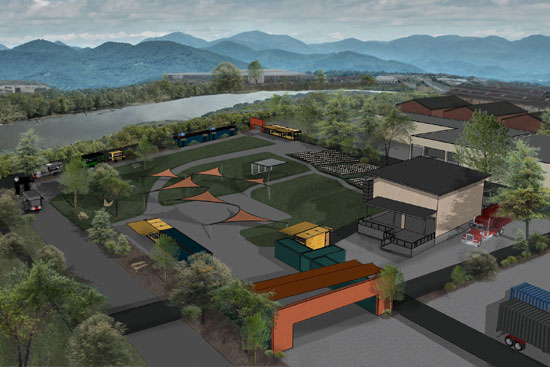
Hellbender’s design takes into account the restrictions posed by the property’s location in floodway and floodplain zones. It also figures in budgetary limitations. “We don’t have $20 million to build out concrete stairs everywhere,” Tallent says. “Nor would doing that be the right design.” Instead, most everything about Hellbender has a charmingly improvised and modular character to it, from the portable stage (which will be replaced this winter with a larger one) to the repurposed shipping containers that will serve as box office, bathroom facilities and merch stand.
The large, open space in front of the stage is gently graded, some six feet higher at the back. That design will offer concertgoers improved sight lines wherever they are. Beyond the grassy area – turning greener by the day as of this writing – several trees provide a shady area that still offers clear view of the stage. The backline of the plot is home to bathrooms; additional portable toilets are situated closer to the stage and entrance. Buildings adjacent to the open area have been renovated, providing materials storage and “green room” facilities for performers and crew.
Working with audiovisual production company PisgahAVL, Hellbender will feature a state-of-the-art sound system from Asheville-based d&b audiotechnik. Major touring acts include exacting requirements in their contract riders, and according to PisgahAVL co-owner Robert Shaffer, “d&b [gear] is on the top of the list” on those riders. The audio system for Hellbender is the same one used by Taylor Swift on her Eras Tour. Noting the new venue’s proximity to residential apartments, Shaffer emphasizes that the technologically advanced d&b setup “keeps the sound in the audience area, and away from anywhere we don’t want it.”
Hellbender by the Numbers
Hellbender is designed to accommodate a range of audience sizes, but Tallent says that its primary goal is to offer a space for higher-profile touring acts that draw a large numbers of concertgoers. “The smallest crowd that would make sense here is about 2,000-2,500 people,” she says. “We’re looking to book shows of that size, all the way up to 6,000 [attendees].” Tallent says that Hellbender’s “sweet spot” will be between 3,500 to 4,800 concertgoers.
Addressing the challenge of providing parking for those attendees figured early into the Hellbender project. In cooperation with the nearby Asheville Mall, the team has coordinated a free shuttle parking program that will get concertgoers from the mall’s 5,000-space lot to the venue and back with minimal fuss. In addition, owners of businesses adjacent and near to Hellbender will offer 800 spaces of paid parking. Concertgoers who pay to park will have a very short walk to the Hellbender entrance on Thompson Street, and parking fees will provide a sorely needed revenue stream. “Those property owners lost their businesses, but what they do have is land,” Tallent says.
Ambitious (Yet Human-scale) Plans
As far as the mix of musical styles that Hellbender will host, Tallent promises eclectic variety. “We try to offer something for everyone,” she says, conceding that the venue is better suited for some genres than others. “We’re operating in the summer, and it doesn’t get dark until 9:30,” she says. (And sound ordinances require a hard stop at 10 p.m.) “So,” she says with a chuckle, “it’s not a great place for an electronic band that wants a midnight laser show.” The venue’s inaugural 2025 season features several big names, with headliners including Rhiannon Giddens, Mavis Staples, LCD Soundsystem, Gov’t Mule, Geese, Wednesday and other name acts. Future seasons will feature around 30 concert dates.
The Orange Peel operation has grown to be a substantial employer in the region. “Between production staff, box office and ticketing, bar staff, show management and so on, we employ about 200 folks during a concert season,” Tallent says. And as the date of Hellbender’s first show approaches, that team is taking an all-hands-on-deck approach. Motioning across the open space toward the tree-shaded zone, Tallent says, “That’s our head of security pushing a wheelbarrow.” McAdams has been impressed with the pace and quality of the work. “I see people working so hard, doing incredible things,” he says. “Moving mountains, as it were.”
“In the live music industry, I haven’t come across a better team than this one,” Tallent says. “While I have every confidence that we’ll encounter challenges, I have every confidence that we’ll meet those challenges. And we’ll learn as we go.”
About the Author

Bill Kopp
With a background in marketing and advertising, Bill Kopp got his professional start writing for Trouser Press. After a stint as Editor-in-chief for a national music magazine, Bill launched Musoscribe in 2009, and has published new content every business day since then (and every single day for several years). The more than 5000 interviews, essays, and reviews on Musoscribe reflect Bill's keen interest in American musical forms, most notably rock, jazz, and soul. His work features a special emphasis on reissues and vinyl. Bill's work also appears in many other outlets both online and in print. He regularly hosts lecture/discussions on artists and albums of historical importance (including monthly events Music to Your Ears and Music Movie Mondays), and is a frequent guest on music-focused radio programs and podcasts. In Spring 2023 he taught a history of Rock 'n' Roll at UNC Asheville's College for Seniors. He also researches and authors liner notes for album reissues -- some 40 to date -- and co-produced a reissue of jazz legend Julian "Cannonball" Adderley's final album. His first book, Reinventing Pink Floyd: From Syd Barrett to The Dark Side of the Moon was published by Rowman & Littlefield in 2018, and in paperback in 2019. His second book, Disturbing the Peace: 415 Records and the Rise of New Wave, was published in 2021 by HoZac Books. His third book, What's the Big Idea: 30 Great Concept Albums is available now. Read even more about him here.