
Album Review: Ray Barretto – Acid
 Launched in New York City in 1964, Fania Records quickly became a major force in the salsa music world. Over the years, Fania has released important works by some of the genre’s biggest exponents, including Willie Colón, Rubén Blades, Celia Cruz and many others. I wrote a bit about Fania in early 2025 when reviewing the excellent compilation Fania Records: The Latin Sound of New York (1964-1978).
While Fania focused nearly exclusively on salsa, the label did what it could to break out to a larger audience. And while Ray Barretto was already a well established and respected artist in his own right, he wasn’t above trying to earn more fans by broadening his appeal. So both label and artist should be forgiven for a bit of misdirection in releasing Barretto’s 1968 with the title Acid.
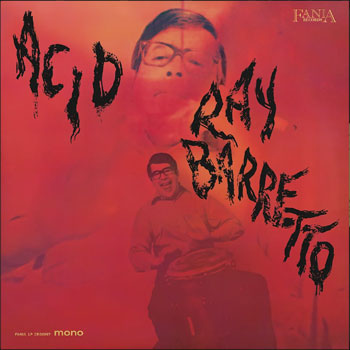
Housed in a lurid red cover with suitably “freaky” title lettering, Acid is not, in fact, an acid-rock LP. In fact it’s not an acid-anything record. What it is, however, is a superb and highly exuberant showcase of soulful salsa, late sixties version.
Barretto was already known for his crossover forays; previous albums sported titles that telegraphed the intent: Viva Watusi! and Señor 007 (both 1965), and 1967’s Latina Con Soul made it plain that the percussionist and band leader wanted a piece of the larger action.
But Barretto did it boldly and on his own terms. Leading an eight-man band and reigning behind a set of congas, Barretto delivered eight spirited tracks on Acid (as it were). A familiar signature riff and classic Cuban-style rhythms are the basis of “El Nuevo Barretto.” In truth it’s not all that nuevo, but boy-oh-boy is it fun. Irresistibly exciting and alluringly hypnotic, the tune has that sawing rhythm paired with ganged/harmony vocals and bursts of lead trumpet bringing even more thrills. (And it goes without saying that the polyrhythms are first-rate, as is the piano solo).
“Mercy Mercy Baby” digs deep into groove territory; it’s sexy stuff. The tune is quite short on lyrics, but words aren’t the point here. The indelible groove reigns supreme. The title track features some impassioned trumpet work and even more thrilling percussion. It’s less a song than a sonic groove-canvas for soloing, but within that framework, it’s classic.
The final song on Side One will be well-known to fans of ‘90s alternative rock. In 1990 Dutch band Urban Dance Squad released a song called “Deeper Shade of Soul,” and earned a Billboard hit single for their trouble. The song is said to “sample” Barretto’s Acid track “A Deeper Shade of Soul” (note the leading “A”), but that description is too generous to the Netherlanders. Fine as their tune is, it simply couldn’t exist without Barretto’s original. Their track isn’t so much sampling the 1968 track as it is completely and utterly built upon and around it. And as much as UDS’ tune is an undeniably fun listen, it pales when held up again Ray Barretto’s recording. (In a bit of retrospective irony, Barretto’s “A Deeper Shade of Soul” itself lifts directly from Eddie Floyd’s “Knock on Wood,” but that’s another story.)
Side Two’s “The Soul Drummers” is more infectious groove. Hypnotic in the extreme, it may well move non-dancers to, well, move. “Sola Te Dejaré” is the most authentically salsa-fied track on Acid; it’s rooted less in groove (albeit still mucho groovy) and more in melody and polyrhythms. It also sounds a lot like the live music I heard all over Cuba when I visited the beleaguered island nation last year.
“Teacher of Love” is as sexy as its title telegraphs. More vocal-forward than most of the other Acid tracks, it’s built around a two-chord foundation with bursts of horns, varied vocal textures and a very with-it bass line from a musician credited only as “Big Daddy.”
Acid concludes with “Espíritu Libre,” which translates as “True Spirit.” The tracks is a bit of an outlier on the album, as it takes its time to get going; all the other cuts are immediate, delivering the goods right out of the gate. It’s jazzy and dissonant in a way that the rest of the record is not, but it’s fascinating nonetheless. At eight-plus minutes, the exuberant exotica of “Espíritu Libre” might be a bit much for those lured in by the groove, but it’s a worthwhile listening experience.
Vocalist and guiro player Pete Bonet lent a deeply idiosyncratic liner note essay to the back of the original LP, and it’s reproduced here along with the album art. It’s must-read stuff, though it will leave those unfamiliar with Barretto’s body of work more than a little perplexed. But if it – and the fine music on Acid – leads them in the direction of more from Ray Barretto and/or Fania Records, that will be muy bueno.
About the Author

Bill Kopp
With a background in marketing and advertising, Bill Kopp got his professional start writing for Trouser Press. After a stint as Editor-in-chief for a national music magazine, Bill launched Musoscribe in 2009, and has published new content every business day since then (and every single day for several years). The more than 5000 interviews, essays, and reviews on Musoscribe reflect Bill's keen interest in American musical forms, most notably rock, jazz, and soul. His work features a special emphasis on reissues and vinyl. Bill's work also appears in many other outlets both online and in print. He regularly hosts lecture/discussions on artists and albums of historical importance (including monthly events Music to Your Ears and Music Movie Mondays), and is a frequent guest on music-focused radio programs and podcasts. In Spring 2023 he taught a history of Rock 'n' Roll at UNC Asheville's College for Seniors. He also researches and authors liner notes for album reissues -- some 40 to date -- and co-produced a reissue of jazz legend Julian "Cannonball" Adderley's final album. His first book, Reinventing Pink Floyd: From Syd Barrett to The Dark Side of the Moon was published by Rowman & Littlefield in 2018, and in paperback in 2019. His second book, Disturbing the Peace: 415 Records and the Rise of New Wave, was published in 2021 by HoZac Books. His third book, What's the Big Idea: 30 Great Concept Albums is available now. Read even more about him here.