
Bayete’s Electric Gospel: ‘Seeking Other Beauty’ (Part 1 of 2)
A shorter, edited version of this interview was previously published in The Tonearm.
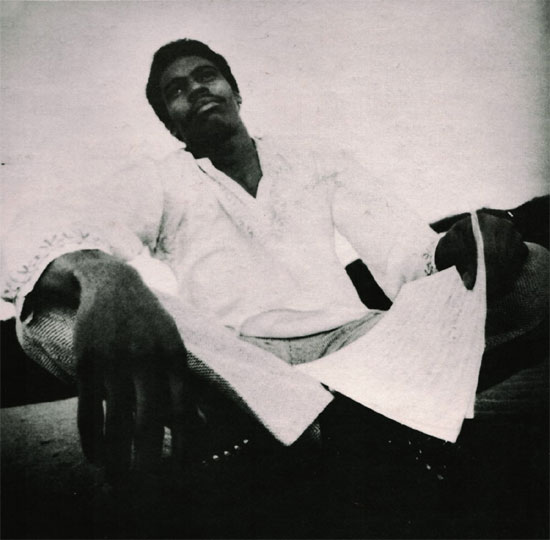
Coming out of a classical and jazz foundation, Bay Area-based composer and multi-instrumentalist Bayeté (Todd Cochran) created a pair of fascinating albums in the early 1970s. While his later efforts – including work with Automatic Man and Carl Palmer – would continue his musical exploration, on 1972’s Worlds Around the Sun and Seeking Other Beauty from 1973, he embarked upon a fascinating journey that drew upon jazz, funk, soul and other forms to express a unique musical vision. Out of print for many years, Worlds Around the Sun received a curated reissue in 2014.
Now in 2026, Bayeté’s adventurous followup Seeking Other Beauty has been reissued on vinyl. Both as an exemplar of a time when boundary-smashing fusion was in its ascendancy and as a timeless work that pays creative dividends more than a half century after its creation, Seeking Other Beauty is a special record. I spoke with Bayeté about the context in which the album was created, the forces that influenced it, and the ways in which it fits into the larger picture.
Bill Kopp: You composed most of the music on Bobby Hutcherson’s 1972 LP Head On. How did your time working with him inform your own creative path?
Todd Cochran/Bayeté: It was really quite something, because I came into this world of jazz when I was very young. I started playing with John Handy when I was 16, 17 years old, and I was writing for John. So my experience has always been intergenerational. Bobby was 10, 12 years older than me, so that was a different type of dynamic. I was always learning, always with manuscript paper and pencil in hand, working with him and following his impulses. And it had a huge impact on me, because I saw how he processed information. I saw how he answered questions. And certainly I saw that there were no boundaries to his creativity when he entered that state. So what I did, I learned how to support that and even how to introduce that setting that allowed that freedom to occur. That’s one of those settings where language can even confuse what it is that you’re trying to explain; sometimes it falls short, because it changes all the time. It’s completely fluid.
What I learned from him is about the state of improvisation. Those of us who think that we’re free in our lives, free to express ourselves and to be who we are, I think we can attribute some of that to [the fact] that we’re improvising as we go through our day. When we do that, it brings some mystery into the equation and the experience. And Bobby Hutcherson really helped me to understand that. He was a prestidigitator as well; he had sleight-of-hand. You would see things that you wouldn’t hear, and then you would hear things that you didn’t see. You would think that you were hearing more music than is actually there.
When you set out to make Seeking Other Beauty, how did your musical objectives differ from when you made Worlds Around the Sun just a year earlier?
My intention had shifted. My tools had changed. My philosophy was progressing, even though I don’t think I even had a philosophy then. And so as a result, the progression between those two records is clearer. On Worlds Around the Sun, I had written “Free Angela,” which is a homage to Angela Davis. Coming up in the environment that I did in San Francisco, I was an accidental activist; I didn’t plan to do it. It was just reality for me to speak on and reflect what was occurring in the environment; that was what was relevant.
I had stepped away from working with the jazz masters like Rahsaan Roland Kirk and Woody Shaw. That was great, but I was really feeling that pull to speak to my generation. Things had been excited within me about how people were taking the color of language and introducing that to a social context in a kind of cultural transference of awareness or consciousness. And out of it came this new music that was touching people in a very deep way.
I had several practices going on at the time. And one of the main ones for me was the written word, poetry, what was being written, new ways of shaping ideas. There was also the presence of futurists, which we don’t have anymore: people like Alvin Toffler, Buckminster Fuller, Stanley Delaney, Octavia Butler. The futurists were taking us out of context of the present; they created a collision of those things in a forward sense. And that really excited me, because if you can move out of the past and out of the present, you can create a world, and you invite people to join you. And then some real storytelling can occur.
Some of what I hear, especially on Seeking Other Beauty, are some root ideas that I also hear from, say, Parliament Funkadelic around that time. Even though you were operating in very different spheres, did you see yourself as kindred spirits?
I understood it and I dug it. But who I was really impacted by was Sly Stone, because he was San Francisco. Growing up, I would listen to Sly Stone on the radio five nights a week. His show’s opening theme song was Ray Charles’ “Let’s Go Get Stoned.” And from there, he was the man. He was a hell of a disc jockey. He was historically rooted; he took us through the whole evolution of the music. He would improvise live. He would talk to someone on the phone, and then he would improvise something with the guitar and voice. Lyrics would just flow.
This was something that I had to experience completely by myself, because I was supposed to be asleep! My dad had given me a transistor radio, and I always figured out a way to have enough money so I could have a battery so the radio would work. And I would listen to it under the covers. I heard Sly, and then I saw how he grew, because he was playing locally. And then I saw how he was impacting people.
About the Author

Bill Kopp
With a background in marketing and advertising, Bill Kopp got his professional start writing for Trouser Press. After a stint as Editor-in-chief for a national music magazine, Bill launched Musoscribe in 2009, and has published new content every business day since then (and every single day for several years). The more than 5000 interviews, essays, and reviews on Musoscribe reflect Bill's keen interest in American musical forms, most notably rock, jazz, and soul. His work features a special emphasis on reissues and vinyl. Bill's work also appears in many other outlets both online and in print. He regularly hosts lecture/discussions on artists and albums of historical importance (including monthly events Music to Your Ears and Music Movie Mondays), and is a frequent guest on music-focused radio programs and podcasts. In Spring 2023 he taught a history of Rock 'n' Roll at UNC Asheville's College for Seniors. He also researches and authors liner notes for album reissues -- some 40 to date -- and co-produced a reissue of jazz legend Julian "Cannonball" Adderley's final album. His first book, Reinventing Pink Floyd: From Syd Barrett to The Dark Side of the Moon was published by Rowman & Littlefield in 2018, and in paperback in 2019. His second book, Disturbing the Peace: 415 Records and the Rise of New Wave, was published in 2021 by HoZac Books. His third book, What's the Big Idea: 30 Great Concept Albums is available now. Read even more about him here.