
Armageddon’s First and Last Stand (Part 3 of 3)
Continued from Part Two…
The first time I heard “Silver Tightrope,” I thought, “This sounds a little bit like Yes…” I felt like it shared some of the progressive qualities of that band. Were you specifically aiming to try to come up with ambitious, progressive arrangements?
Martin Pugh: I think it just happened naturally. It’s just one of those things that came up. And then of course, Keith put those great lyrics to it. For the middle part, I was slightly inspired by Erik Satie. I was a great fan of him. I didn’t copy anything, but it’s got that vibe. I wanted it to mellow out in the middle, then Bobby comes in with the drums, and then we take it on out.
But I don’t think “Silver Tightrope” was inspired by those type of bands, though. It’s hard to say; we played with Yes quite a few times in Germany, so who knows what enters your head?
Was “Basking in the White of the Midnight Sun” – the epic tune on Armageddon – written as a multi-suite piece, or was it a series of pieces that you decided to stitch together?
I think it was written as a piece. The last part [“Basking in the White of the Midnight Sun (Reprise)”] was a vehicle for Keith’s harmonica and my guitar to interact. We might have come up with that part after we had been practicing at A&M, when we went to England to record at Olympic. We went to Clearwell Castle for a couple of weeks; we all lived there, and we had a basement set up with all the gear.
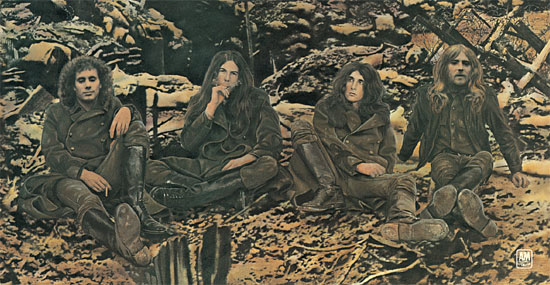
Regarding the mix on the album, Keith’s vocals are – to put it diplomatically – not as out front as I might have expected. Why did it happen that way?
I think it’s probably a mistake [that occurred] when we were mixing the album. We elected not to have a producer, which in hindsight may have been a problem. But we were bullheaded and strong; it was like, “We’re not having anybody come in here and tell us.” From my point of view now, if you’ve got the right producer, he can tell you, “That is not working; what you just did is not working.” It’s maybe harder to tell yourself that.
We mixed it at Olympic. When you’re mixing, you try to listen through various speaker combinations, and at some point you’ve got to say, “Let’s go with that.” But yeah, I agree with you. I’ve always wished that some of the vocals were a little [louder]. I think that for the newer release that they’ve just done, the vocals are a little bit more recognizable.
Did they have access to the multi-track masters for this release?
No, I don’t think so. But I think they did put it through some kind of mastering program.
Was Armageddon’s deal with A&M a one-album contract from the get-go, or was it a case of, “Do one and see how it goes”?
It was a one-album deal, but open-ended.
Also, when the album was just peaking – “Silver Tightrope” was definitely in the charts in the Midwest and doing really well – we were due to go out and open up for Eric Clapton on his 461 Ocean Boulevard tour. It was set up initially by Jerry Weintraub, who was a big manager at the time. He put us on that tour; we were rehearsed and ready to go. And then at the last minute, we were told we weren’t going to be on that tour. Nobody ever told us why.
In the end we only played two nights in Los Angeles at the Starwood Club. They were the only live gigs that Armageddon ever played.
Only two total!? I understand that the tour didn’t happen, but why were there no other gigs beyond those two?
Because the tour was planned. When a tour falls through, then you’ve got to recalibrate. It just didn’t ever happen; that was the time we should have gone out and started touring the States like everybody else. And I think it could have been a much bigger album. [A&M] made it quite clear that they were behind us for the long haul. Unfortunately, Keith’s demise didn’t allow that to happen.
There are multiple guitar parts on the album; interesting things are going on all over the songs. Even though you only did the two gigs, how did you pull that off live with just you on guitar? I would have thought that if you were going to do it live and have the music sound anything like the record, you’d have to bring along another guitarist.
Right. For one song, we had put together a backing track playing the arpeggiated riff, syncing it up. That’s easy these days. One night, it worked a charm. The second night it got a little bit backward, but we ended up finding our way with it. The other songs were heavy enough where we could get away with one guitar.
How did this new reissue come about after all these years?
The story is that my wife Linda and I had been talking about it all year: “It’s the 50th anniversary. All these other bands are putting things out. I wish we could do an Armageddon [reissue].” And then about three months ago, I found out that Deko Entertainment had applied to Universal [Music Group] at the beginning of the year. Louis had said something to Linda on Facebook, and then I inquired about it and they were like, “Oh, yeah, this is coming out.” It had taken quite a long time for them to put all the ducks in line.
I got in touch with Deko, and they sent me 100 copies to sign. It was amazing; it’s like a dream come true. I couldn’t ask for more. I told Charlie [Calv] at Deko, “Thank you so much for doing that. We’ve been under the radar with that album, so for some people to suddenly think it was worthwhile to do that, it’s just great.
About the Author

Bill Kopp
With a background in marketing and advertising, Bill Kopp got his professional start writing for Trouser Press. After a stint as Editor-in-chief for a national music magazine, Bill launched Musoscribe in 2009, and has published new content every business day since then (and every single day for several years). The more than 5000 interviews, essays, and reviews on Musoscribe reflect Bill's keen interest in American musical forms, most notably rock, jazz, and soul. His work features a special emphasis on reissues and vinyl. Bill's work also appears in many other outlets both online and in print. He regularly hosts lecture/discussions on artists and albums of historical importance (including monthly events Music to Your Ears and Music Movie Mondays), and is a frequent guest on music-focused radio programs and podcasts. In Spring 2023 he taught a history of Rock 'n' Roll at UNC Asheville's College for Seniors. He also researches and authors liner notes for album reissues -- some 40 to date -- and co-produced a reissue of jazz legend Julian "Cannonball" Adderley's final album. His first book, Reinventing Pink Floyd: From Syd Barrett to The Dark Side of the Moon was published by Rowman & Littlefield in 2018, and in paperback in 2019. His second book, Disturbing the Peace: 415 Records and the Rise of New Wave, was published in 2021 by HoZac Books. His third book, What's the Big Idea: 30 Great Concept Albums is available now. Read even more about him here.