
Album Reviews: Two from Rahsaan Roland Kirk
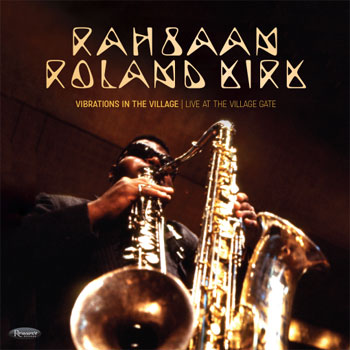 I’m going to veer off on a wild tangent in my approach to this review of this pair of new titles from Resonance Records. If that approach isn’t in line with your needs, you have been warned.
In or around the middle 1990s, I was making my then-customary Saturday morning roundup of garage sales when I happened upon a home that led me to think, “I’ll bet these people have some cool records.” This was that curious time during which vinyl had fallen completely out of fashion, so much so that many garage-sellers didn’t even think to bring their now-dormant LPs out to the sale. So it would be left to me to inquire. Often as not, they’d reply along the lines of, “Oh, yeah; they’re in the living room. Follow me.”
Follow I did. And in particular this case, what I found was a cache of jazz LPs. At the time, my knowledge of classic jazz was so minimal that scientific instruments had yet to be invented that were sensitive enough to detect it. So I bought exactly one of those records: Somethin’ Else, a 1958 disc credited to Cannonball Adderely and featuring (like it says on the cover) Miles Davis, Hank Jones, Sam Jones and Art Blakey.
Quite a find it was. Looking back, I shudder to realize how many other gems were left behind in that stack. But no regrets, as Somethin’ Else changed my life. It was, as I have written before, my true gateway into jazz.
In the years since, I’ve learned a thing or two about jazz. I am still far from an expert; what I bring to a discussion of the genre is the perspective of a rock fan. For better or worse, my takes on jazz records are the product of someone who grew up immersed in the conventionally melodic idioms of rock, pop and soul.
For that reason, perhaps, soul jazz is my hands-down favorite style of jazz. I love other styles: third stream, fusion, hard bop, cool jazz, on and on. But soul jazz – with its emphasis on melody, a kind of secular gospel musical perspective – is the sweet spot for me.
Somehow, though, it has taken me awhile to gain exposure to all of the greats. I’m still working on it. And while I had heard the name Rahsaan Roland Kirk many times – within the context of jazz and outside of it – I had never heard so much as a note of the man’s music, and – other than references – had never read anything about him or his music.
When I did stumble across Kirk’s name, it was – you guessed it – in the context of his oversize influence on one Ian Anderson. The Jethro Tull leader/mainstay has always been candid about how much Kirk’s approach to the flute influenced his own style. I have long “known” this, but as for what it really meant in terms of style, I remained unaware.
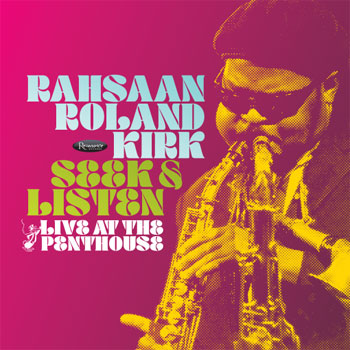 Which finally brings me to a pair of previously-unreleased recordings. Vibrations in the Village captures Kirk and his band at Greenwich Village’s storied Village Gate, on two consecutive nights in late November 1963. (Fun fact: I was born the following week.) Another new set, Seek & Listen: Live at the Penthouse is a 2CD collection documenting a pair of shows in Seattle in September 1967. So my introduction to Rahsaan Roland Kirk was not one of his classic albums, but a pair of soundboard recordings unearthed by Zev Feldman and his intrepid team of archivists.
It should go without saying that both albums feature superb sonic clarity; that standard is one from which Feldman (via multiple labels including Resonance) has steadfastly held. The quality of the packaging – design, photos, essays and such – is also predictably first-rate. But what is truly special – and for me, revelatory – is the musicianship and the accessibility on display throughout both albums.
If people know one thing about Rahsaan Roland Kirk, it’s that he could play multiple instruments at once. Reading that for the first time might elicit a raised eyebrow or two. But hearing it, as I learned, is another matter entirely. Throughout the tunes on all of these live dates captured on these new releases, Kirk starts out playing a single instrument: maybe it’s tenor sax, maybe flute. But then – right at the point in which other horn players might be expected to join in – or sometimes at another point in the tune – all of a sudden we’re hearing a horn section. Maybe in unison, maybe with one horn playing a counterpoint to the melody of another, maybe one holding a long note while the other sends forth a wild succession of melodic flights.
And it’s all Rahsan Roland Kirk. He’s joined only by piano, bass and drums. Kirk variously plays (per the album credits) tenor sax, stritch (a straight alto sax without a bell), manzello (a modified saxelle), flute, whistle, flexatone, siren and “et cetera.” He sings, too, ferchrissake, and he does so in between blows on his horn(s). For someone who’s never heard it, it’s – forgive me – breathtaking. And melodic in the extreme, which is a nice bonus where live jazz is concerned.
A bit about the Ian Anderson connection. I now understand that what he got from Kirk was his approach of blowing madly – bellowing, really – into the flute for an effect that’s somewhere between vocalizing and playing the instrument. Certainly there’s much more to Anderson’s style and technique than that – and far, far more to what Kirk did – but the line between the two is now clear.
When I stumbled across that classic Adderley LP three decades ago, it was a life-changing experience. I didn’t expect that another such moment would come at all, much less in the form of archival releases from Rahsaan Roland Kirk. These two albums might not change your life, but then again: they might. And even if they don’t, they could well add great pleasure to it. Highly recommended.
About the Author

Bill Kopp
With a background in marketing and advertising, Bill Kopp got his professional start writing for Trouser Press. After a stint as Editor-in-chief for a national music magazine, Bill launched Musoscribe in 2009, and has published new content every business day since then (and every single day for several years). The more than 5000 interviews, essays, and reviews on Musoscribe reflect Bill's keen interest in American musical forms, most notably rock, jazz, and soul. His work features a special emphasis on reissues and vinyl. Bill's work also appears in many other outlets both online and in print. He regularly hosts lecture/discussions on artists and albums of historical importance (including monthly events Music to Your Ears and Music Movie Mondays), and is a frequent guest on music-focused radio programs and podcasts. In Spring 2023 he taught a history of Rock 'n' Roll at UNC Asheville's College for Seniors. He also researches and authors liner notes for album reissues -- some 40 to date -- and co-produced a reissue of jazz legend Julian "Cannonball" Adderley's final album. His first book, Reinventing Pink Floyd: From Syd Barrett to The Dark Side of the Moon was published by Rowman & Littlefield in 2018, and in paperback in 2019. His second book, Disturbing the Peace: 415 Records and the Rise of New Wave, was published in 2021 by HoZac Books. His third book, What's the Big Idea: 30 Great Concept Albums is available now. Read even more about him here.