
Killer Queen: Guaranteed to Blow Your Mind (Part 1 of 2)
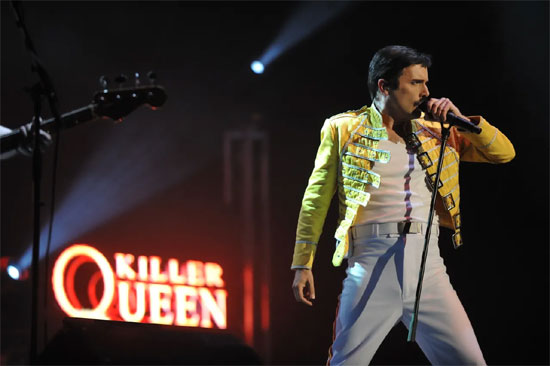
In 2025, tribute bands are a major segment of the music industry. Fans who perhaps never got to see their favorite classic rock band – or who want to relive the experiences of when they did – react with enthusiasm when a quality tribute band comes to town. But back in the late ‘90s when the group tat would become Killer Queen first got stared, the concept of tribute rock bands hadn’t come into being. A combination of being in the right place at the right time, coupled with talent and dedication, set Killer Queen on a course that continues today, three decades after their launch. Ahead of a North American tour, Killer Queen’s lead singer Patrick Myers recounts how he went from being a student to the becoming the onstage embodiment of the late great Freddie Mercury.
Tell me how you first got into the music of Queen and the larger-than-life personality of Freddie Mercury.
I’d been a Queen fan since about age 13, 14, I think, and I sort of cut my teeth on their music. I had played their songs at school, in concerts and things like that. But I never thought that it would become something, because back in ‘91, tribute bands didn’t really exist.
In the winter of 1991, we were just students getting to know each other. We “got” each other through Queen and [David] Bowie, with a little bit of Led Zeppelin thrown in; they were the ones everyone seemed to agree were brilliant and had been really exciting in our lives. But we weren’t thinking about it other than that just as a way of getting to know each other. We’d talk about which albums we liked, and all that sort of stuff; just general conversations about that sort of thing.
And then we got the news that Freddie was ill and then had died and it suddenly turned everything on its head. We were all in shock – a massive shock – because I stupidly hadn’t even realized he was ill. I’d seen he’d looked a lot older and had seemed to be aging a lot faster than the rest of the band.
I knew he’d had his wild times, but it still never crossed my mind that he was going to be dying of AIDS. I just thought he was all right; back in the ‘80s he’d said in interviews that he’d been tested and he was fine. And I just assumed, “Oh, thank God he’s all right then.”
So I was completely blindsided by [his death]; we all were. And we started playing the songs to each other. There was a battered old piano in a laundry room, and we played the songs to each other; we’d start showing each other how each song went.
At the same time, that Christmas, I went home and was messing about with my mum’s makeup kit. I had a beard that was only half grown and I wanted to color it in a bit with a mascara so I could go out and see my friends and pretend: “Look! I could grow a beard! How grown up am I, right?” I was only about 20 or something.
Just by chance, I was wearing a brilliant blue shirt with a polka dot red tie, which Freddie had worn in his last interview in videos. I hadn’t bought them with the view of looking like Freddie; I just happened to have those things. And I was trying to dress up because it was Christmas.
So I had a combination of the mascara and the clothes. I suddenly thought, “Oh, look! I’m wearing stuff that Freddie did, and I’ve got a beard like Freddie had.” So I pulled a “Freddie face” face in the mirror. That’s the first time I’d ever done that, and I suddenly realized if I did that, my face could look like Freddie Mercury’s.
I’d always been a vocal mimic and I’d mimicked people that I loved, so I’d mimic John Lennon and Paul McCartney and Elvis Costello and Bono and Lou Reed and anyone with a distinctive voice. And – though I found him difficult to mimic because he had a beautiful voice – I mimicked Freddie. And I thought, well, maybe…
About the Author

Bill Kopp
With a background in marketing and advertising, Bill Kopp got his professional start writing for Trouser Press. After a stint as Editor-in-chief for a national music magazine, Bill launched Musoscribe in 2009, and has published new content every business day since then (and every single day for several years). The more than 5000 interviews, essays, and reviews on Musoscribe reflect Bill's keen interest in American musical forms, most notably rock, jazz, and soul. His work features a special emphasis on reissues and vinyl. Bill's work also appears in many other outlets both online and in print. He regularly hosts lecture/discussions on artists and albums of historical importance (including monthly events Music to Your Ears and Music Movie Mondays), and is a frequent guest on music-focused radio programs and podcasts. In Spring 2023 he taught a history of Rock 'n' Roll at UNC Asheville's College for Seniors. He also researches and authors liner notes for album reissues -- some 40 to date -- and co-produced a reissue of jazz legend Julian "Cannonball" Adderley's final album. His first book, Reinventing Pink Floyd: From Syd Barrett to The Dark Side of the Moon was published by Rowman & Littlefield in 2018, and in paperback in 2019. His second book, Disturbing the Peace: 415 Records and the Rise of New Wave, was published in 2021 by HoZac Books. His third book, What's the Big Idea: 30 Great Concept Albums is available now. Read even more about him here.