
Album Review: Chris O’Leary – Blue Collar
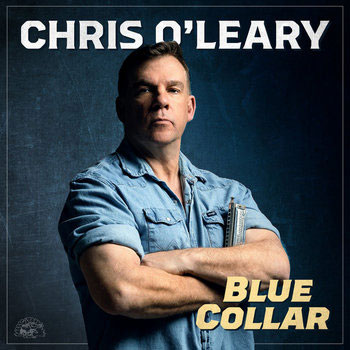 Singer Chris O’Leary earned his stripes fronting Levon Helm’s band, The Barnburners. O’Leary was with that group on vocals and harp for six years, 1999-2005. Setting out on his own, O’Leary debuted with 2011’s Mr. Used to Be, credited to the Chris O’Leary Band. The group was named Best New Artist at that year’s American Blues Music Awards.
O’Leary then released a string of albums for small labels. During that time he caught the attention of Alligator Records, who signed him and released his major-label debut, The Hard Line, in 2024. Now in 2026 O’Leary returns with his second Alligator release, Blue Collar.
O’Leary’s core band on Blue Collar includes guitarist Pat O’Shea, Shiela Klinefelter on bass and drummer Chuck Cotton. An extensive roster of guest players contributes in various ways on an assortment of tracks. The ubiquitous and in-demand Kid Andersen recorded the sessions at his famed Greaseland USA studio in San Jose; O’Leary is credited as the album’s producer.
O’Leary’s assertive vocals are paired with lyrics built around street-level stories. The loping “Bad Decisions” opens the new record, setting a tone that’s gritty, unalloyed and authentic. O’Leary’s wailing harp is a highlight of the track. On “Lady Luck,” the band ventures confidently into territory reminiscent of the Fabulous Thunderbirds. His harp blowing engages in fierce dialogue with the lead guitar.
The fiery “One More Cup of Coffee” is well-named: the band sounds is if every player downed several espressos before rolling tape. Lil’ Ed Williams’ slide work on the track is appropriately frenzied, and the ganged backing vocals strike just the right tone.
Most listeners will need to catch their breath after experiencing that track, and the swaggering, slow blues of “Nothing But a Memory” provides just such an opportunity. There’s plenty of passion in the track, and more than a little bit of menace. The retro, jump blues-flavored textures of “Justice Must Be Blind” are not only supremely entertaining; they underscore O’Leary’s command of styles.
“One Way Street” makes that point yet again; this time O’Leary traffics in a New Orleans style. That feel is furthered by tuba and trombone from Luke Kirley, and the arrangement breaks out of the Crescent City mold a bit with a tasty guitar solo (and of course more wild harp work). The peppy “Live Baby Gators” applies a bit of country flavor to its story, and all concerned sound like they’re having a helluva time. (Wayne Toups’ accordion solo is a nice touch, too.)
The subtle and sleek “How’d I Ever Get Along” provides a respite from the raucousness, again making the point that while Blue Collar is wildly varied, it’s expertly and thoughtfully sequenced. And the character changes up yet again for the album’s closer, “Daddy Was a Wolfman.” While the song employs a well-worn melody, O’Leary’s musical storytelling shows him to be a true original.
In many ways, Blue Collar plays like a sampler, showing O’Leary’s keen and well-developed skill at moving between styles. But to its credit, the whole affair holds together as a rewarding listening experience as well.
About the Author

Bill Kopp
With a background in marketing and advertising, Bill Kopp got his professional start writing for Trouser Press. After a stint as Editor-in-chief for a national music magazine, Bill launched Musoscribe in 2009, and has published new content every business day since then (and every single day for several years). The more than 5000 interviews, essays, and reviews on Musoscribe reflect Bill's keen interest in American musical forms, most notably rock, jazz, and soul. His work features a special emphasis on reissues and vinyl. Bill's work also appears in many other outlets both online and in print. He regularly hosts lecture/discussions on artists and albums of historical importance (including monthly events Music to Your Ears and Music Movie Mondays), and is a frequent guest on music-focused radio programs and podcasts. In Spring 2023 he taught a history of Rock 'n' Roll at UNC Asheville's College for Seniors. He also researches and authors liner notes for album reissues -- some 40 to date -- and co-produced a reissue of jazz legend Julian "Cannonball" Adderley's final album. His first book, Reinventing Pink Floyd: From Syd Barrett to The Dark Side of the Moon was published by Rowman & Littlefield in 2018, and in paperback in 2019. His second book, Disturbing the Peace: 415 Records and the Rise of New Wave, was published in 2021 by HoZac Books. His third book, What's the Big Idea: 30 Great Concept Albums is available now. Read even more about him here.