
Album Review: Catfish Keith – Sugar for Sugar
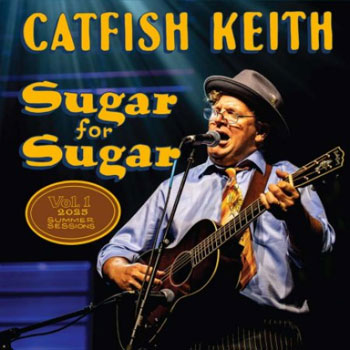 Born Keith Kozacik, Catfish Keith is a singer, guitarist and songwriter whose primary (but notably not only) instrument is the resonator guitar. The East Chicago, Indiana native debuted on record with 1984’s Catfish Blues. Along the way, Catfish Keith has earned an impressive cache of accolades, including Blues Blast Music Awards (four), Blues Music Awards nominations (eight) and induction into the Iowa Blues Hall of Fame. A journeyman musician who has toured overseas more than 50 times, Catfish has released a steady stream of albums; 2025’s Sugar for Sugar is his 24th and latest long-player.
Subtitled Vol. 1: 2025 Summer Sessions, the album features two original numbers plus eight well-chosen songs that highlight the artist’s deep knowledge of acoustic blues and folk. The warm and expansive production (by Catfish and label head Penny Cahill) primarily features nothing more than a single vocal and guitar. Catfish’s arsenal includes two National resonators (one standard and one baritone), three acoustic six-strings (including a “Catfish Special” model) and a Stella-style twelve-string.
The Carter Family’s “Hello Stranger” opens the set in fine fashion. Catfish’s adept picking is precise and tuneful; its busy character contrasts nicely with his straightforward vocal. Blind Willie McTell and Curley Weaver’s “Wee Midnight House” is spare and spooky; a bit of vocal double-tracking adds texture. Another chestnut, “John the Revelator” adds some gospel flavor into the mix, with a bit of tasty slide work.
“Goose Steppin’ Dudes” is a Catfish Keith original that finds the artist engaging in some timely social commentary. Catfish’s guitar capably trades in a ragtime style even without piano. On Lil’ Son Jackson’s “Gambler’s Blues,” Catfish makes effective use of the spaces between the notes. Heightened by insistent stomped-foot percussion, the haunting vibe of the track makes it feel as if it were recorded nearly a century ago. Another original, “Keep Out the Way of the Sheriff” features some wonderfully loose-stringed rattling, buzzing guitar that may remind some listeners of the sounds on Led Zeppelin III.
“I’m So Glad” (the Memphis Minnie tune, not the Skip James classic) is delivered in chirpy, bouncy fashion. Sam McGee’s 1926 “Buck Dancer’s Choice” provides an instrumental showcase for Catfish’s assured and melodic guitar picking; as fine as his vocals are, more like this would make a solid album even better. “James Alley Blues” is another song from 100 years ago, this time from Richard Rabbit Brown; it provides the phrase from which Catfish draws the album title. A contemplative blues, it again highlights Catfish’s guitar mastery. The album wraps with Mississippi Joe Callicott’s “Lonesome Katy,” rendered on the 12-string. His yodeling-style vocal contrasts with the rich tones of the guitar.
About the Author

Bill Kopp
With a background in marketing and advertising, Bill Kopp got his professional start writing for Trouser Press. After a stint as Editor-in-chief for a national music magazine, Bill launched Musoscribe in 2009, and has published new content every business day since then (and every single day for several years). The more than 5000 interviews, essays, and reviews on Musoscribe reflect Bill's keen interest in American musical forms, most notably rock, jazz, and soul. His work features a special emphasis on reissues and vinyl. Bill's work also appears in many other outlets both online and in print. He regularly hosts lecture/discussions on artists and albums of historical importance (including monthly events Music to Your Ears and Music Movie Mondays), and is a frequent guest on music-focused radio programs and podcasts. In Spring 2023 he taught a history of Rock 'n' Roll at UNC Asheville's College for Seniors. He also researches and authors liner notes for album reissues -- some 40 to date -- and co-produced a reissue of jazz legend Julian "Cannonball" Adderley's final album. His first book, Reinventing Pink Floyd: From Syd Barrett to The Dark Side of the Moon was published by Rowman & Littlefield in 2018, and in paperback in 2019. His second book, Disturbing the Peace: 415 Records and the Rise of New Wave, was published in 2021 by HoZac Books. His third book, What's the Big Idea: 30 Great Concept Albums is available now. Read even more about him here.