
Brown Acid: A Trip Worth Taking (Part 1 of 2)
RidingEasy Records’ Brown Acid Series Celebrates its 20th Volume
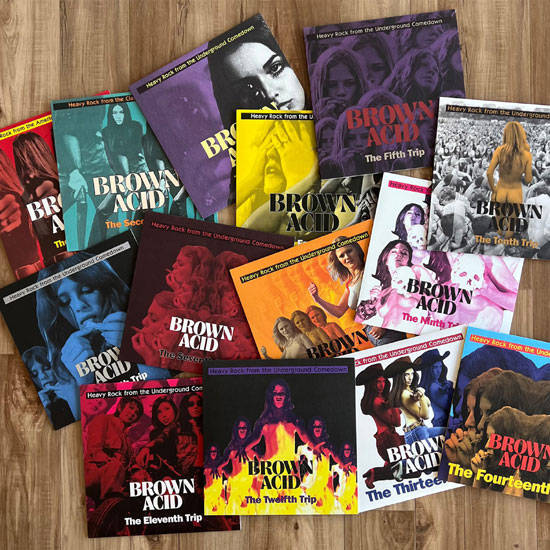
A coveted prize for those who appreciate the heavy sounds of early ‘70s rock, Brown Acid: The Twentieth Trip also represents a milestone for its curators. Collecting extremely rare tracks from one of the most creatively fertile periods in rock history, the Brown Acid series celebrates the release of its 20th volume with the April release. Brown Acid is the brainchild of two record fanatics, RidingEasy Records founder Daniel Hall and Lance Barresi, owner of the brick-and-mortar Permanent Records in Los Angeles.
The project’s two curators already knew each other when Hall launched his San Pedro, California-based label in 2013. “I had a weekly DJ night with Ty Segall called Feed the Freaks,” Barresi says. Barresi’s sets featured exceedingly rare rock singles from his personal collection. Hall says that while he was familiar with some of the 45s Barresi was spinning, many of the tracks were new to him. “It’s crazy how many 45s existed, but flew under the radar,” he muses. “I asked Lance if he could make me a mix to listen to in my car, and he did.”
Hall was thrilled with the collection, and asked Barresi if he ever came across additional copies of any of the rare songs on that mix. “He was like, ‘I have several copies of one of them at the shop.’” Barresi explained that in his quest to unearth obscure heavy rock from the late ‘60s and early 1970s, he had tracked down many of the musicians who made those records. “You know how to get a hold of all these people?!” Hall replied. “Why aren’t you doing a compilation series?” Barresi explained that he didn’t have the wherewithal to undertake such an ambitious project.
But Hall did. “Let’s party,” he told his friend. And so began the Brown Acid series. “I drew up a very simple contract, stating ‘Here’s what we want to do. Here’s how much money you get paid. There’s some money up front, and then there’s royalties that go along with it.’” He and Barresi approached about 50 artists; most were on board right from the start. “Many of them were like, ‘You want to do what?’” Hall recalls with a laugh.
In most cases, the artists recorded those songs when they were 18 to 20 years old; today they’re in their mid-70s or older. They weren’t ever signed to record labels; the bands self-financed recording sessions and paid to have a few hundred copies of their records pressed up for sale at gigs. Often, the songs those young men recorded were the only records they ever made. “And then life kicked in, or they went to Vietnam,” Hall points out. So most responded with enthusiasm at the prospect of having their old music brought to a new audience. “Tracking down the artists was the hard part,” Barresi says. “Getting them to sign on the dotted line was fairly easy.”
“Within two months, we got 30 tracks locked down,” Hall says. The first volume was released in October 2014. “And we knew already that we had enough on deck for a second one.” In fact, they had enough material – quality tracks, cleared for release – to make at least three more volumes in the new series.
The series name came about through brainstorming. “We thought, ‘Let’s explain what this music is,’” Hall recalls. The music explored in the series draws from the post-peace-and-love, just-after-Altamont era. “The Hell’s Angels were stabbing people in front of the Rolling Stones,” Hall says. “There was some bad acid going around, and people were having bad trips. The Laurel Canyon scene had run its course, and the music took a dark turn.” A harder, heavier brand of rock was coming out of garages and basements in Middle America’s working class towns. “So we landed on the name Brown Acid, with the tagline: ‘Heavy Rock from the Underground Comedown,’” Hall says.
Each of the records under the Brown Acid umbrella has its own distinctive character, as well; Hall and Barresi put a lot of thought into which songs should belong together on a record, and in what order. “There’s a through-line with the whole series,” Hall says, “but some might be more proto-metal, some might have an early punk vibe, others a heavy garage vibe.”
About the Author

Bill Kopp
With a background in marketing and advertising, Bill Kopp got his professional start writing for Trouser Press. After a stint as Editor-in-chief for a national music magazine, Bill launched Musoscribe in 2009, and has published new content every business day since then (and every single day for several years). The more than 5000 interviews, essays, and reviews on Musoscribe reflect Bill's keen interest in American musical forms, most notably rock, jazz, and soul. His work features a special emphasis on reissues and vinyl. Bill's work also appears in many other outlets both online and in print. He regularly hosts lecture/discussions on artists and albums of historical importance (including monthly events Music to Your Ears and Music Movie Mondays), and is a frequent guest on music-focused radio programs and podcasts. In Spring 2023 he taught a history of Rock 'n' Roll at UNC Asheville's College for Seniors. He also researches and authors liner notes for album reissues -- some 40 to date -- and co-produced a reissue of jazz legend Julian "Cannonball" Adderley's final album. His first book, Reinventing Pink Floyd: From Syd Barrett to The Dark Side of the Moon was published by Rowman & Littlefield in 2018, and in paperback in 2019. His second book, Disturbing the Peace: 415 Records and the Rise of New Wave, was published in 2021 by HoZac Books. His third book, What's the Big Idea: 30 Great Concept Albums is available now. Read even more about him here.