
Book Review: ‘Euphoric Recall’ by Peter Jesperson
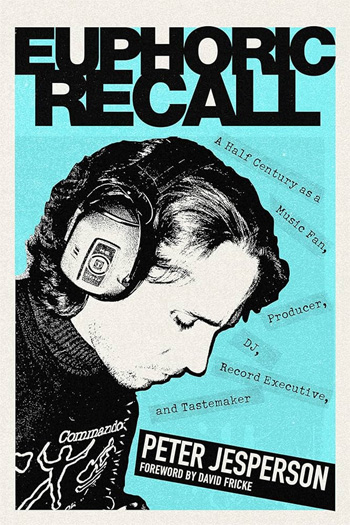 Along with the other ways in which they can function, memoirs often serve as score-settling endeavors. A memoir can represent an opportunity for its author to say I-told-you-so, run a victory lap, explain away poor decisions or bad acts and/or generally have the last (or highest profile) word on a panoply of topics.
Not so with Euphoric Recall. The ironically- and pointedly-titled memoir by Peter Jesperson engages in none of those activities. Instead it’s a clear-eyed, well-remembered account of a life spent in music, both in its creative sphere and in the often rough-and-tumble business side.
There’s that old joke about oxymorons: jumbo shrimp, compassionate conservative, legal brief. Another is music business. When creativity and commerce attempt to coexist, it’s an uneasy alliance. But that tension – and its yields – are at the core of Euphoric Recall. Jesperson’s life is one that will resonate with a good segment of those who read it, as his life trajectory (or at least sections of it) mirror that of many who are passionate about music. Pop music fan, record store employee, musician, band manager, label head… those are all roles into which Jesperson threw himself wholeheartedly.
At one point very late in the book Jesperson owns up to what he characterizes as name-dropping. It’s a needless confession, as his association with all of the names he mentions (and yes, there are very many) has been genuine, legitimate and in most cases quite fruitful and positive. So when one reads about Paul Westerberg, Peter Buck, Kris Kristofferson, Vic Chesnutt, Alex Chilton, Slim Dunlap, Jack Logan and other notable figures in the alt- and otherkindsa-rock worlds, the stories offer insight far beyond mere anecdote recollections.
Within the pages of Euphoric Recall, Peter Jesperson is modest to a fault; if anything, he understates his importance in the stories of the important bands and record labels with which he has been involved. Jesperson has been a key figure – much, much more than a Zelig, even if he’s not a household name – in the stories of Minneapolis’ Oarfolkjokeopus record store, Twin/Tone and New West Records, the Replacements and other bedrocks of the music scene. And he’s counted a long list of major figures as associates and friends.
It’s that latter category – friends – that provides much of the most compelling material in Euphoric Recall. Many of the names figure into Jesperson’s story in on-again, off-again fashion, entering his orbit (or he entering theirs) at a significant point, only to fade away, return and depart yet again.
And what’s remarkable about Jesperson’s telling of those encounters, and how they fit into his larger narrative, is his even-handedness. He never once takes an opportunity to crow about his judgment being vindicated; he never points blame for things-gone-wrong squarely at others.
Instead he goes to sometimes near-heroic lengths to understand why other people said or did the things that yielded unwanted results. If Jesperson was fired or dismissed as a tour manager, A&R man or employee (and indeed he was), Euphoric Recall contextualizes that event in such a way as to say, I can kind of see where he/she/they were coming from. The book often reads like the memoir of someone who has (as they say in the worlds of therapy and recovery) “done the work.”
And in fact Jesperson has done the work. His unvarnished tales of his excessive drinking inform and provide important context for much else that happens within the book’s 275 or so pages. And his account of how and when he got sober isn’t at all preachy or sanctimonious. Significantly, when he explains the meaning of the book’s title, readers will appreciate that no, that’s not at all the approach he is taking to recounting his life story.
At its core, Euphoric Recall is a compelling, fascinating and (yes, entertaining) story well told by an important if largely unsung figure in popular music. It’s enthusiastically recommended especially for fans of the Minneapolis brand of alt-rock, of R.E.M. and of the non-mainstream side of ‘80’s-and-beyond music. But it’s also a highly readable story that will reward listeners less familiar with all that, who instead simply appreciate a good, honest and articulately-recounted memoir.
About the Author

Bill Kopp
With a background in marketing and advertising, Bill Kopp got his professional start writing for Trouser Press. After a stint as Editor-in-chief for a national music magazine, Bill launched Musoscribe in 2009, and has published new content every business day since then (and every single day for several years). The more than 5000 interviews, essays, and reviews on Musoscribe reflect Bill's keen interest in American musical forms, most notably rock, jazz, and soul. His work features a special emphasis on reissues and vinyl. Bill's work also appears in many other outlets both online and in print. He regularly hosts lecture/discussions on artists and albums of historical importance (including monthly events Music to Your Ears and Music Movie Mondays), and is a frequent guest on music-focused radio programs and podcasts. In Spring 2023 he taught a history of Rock 'n' Roll at UNC Asheville's College for Seniors. He also researches and authors liner notes for album reissues -- some 40 to date -- and co-produced a reissue of jazz legend Julian "Cannonball" Adderley's final album. His first book, Reinventing Pink Floyd: From Syd Barrett to The Dark Side of the Moon was published by Rowman & Littlefield in 2018, and in paperback in 2019. His second book, Disturbing the Peace: 415 Records and the Rise of New Wave, was published in 2021 by HoZac Books. His third book, What's the Big Idea: 30 Great Concept Albums is available now. Read even more about him here.