
What Was Old is Neu! Again (Part 2 of 3)
Continued from Part One…
Something Neu! (continued)
For his part, Rother played multilayered electric guitar parts that skittered around, over and under a repetitive, often one-chord musical structure. The meter was running during Neu!’s studio sessions, so to speak. So they had to work quickly and efficiently. “Without having much time to reflect or correct anything,” Rother says, “it was really just ‘throw it at the wall and move on.’”
Many retrospective articles about that first Neu! album acknowledge that it was an artistic triumph, but suggest that the LP was a commercial failure. Rother takes issue with that idea. “Compared to the big pop acts,” he admits, Neu! wasn’t a major seller in Germany. “But for me and for people that were interested in our kind of music, it was quite a success.” He says that if one spent time in downtown Dusseldorf in 1972, Neu! album tracks could be heard coming from local bars. Rother estimates that Neu! sold somewhere around 40,000 copies: not an insignificant figure for a new band that didn’t – couldn’t, really – play live.

Neu! photo by Peter Lindbergh
Neu! booked two shows, but Rother says that those efforts were a disaster. “Klaus and I wanted to play live, but as a duo, it was just impossible,” he says. “Just one guy hitting the drums and one guy playing either rhythm, or rhythm and melody at the same time? That didn’t work! A complete failure.” He and Dinger even tried a show using backing tapes to round out their sound. While that practice is commonplace today, Rother says that in the early 1970s, “people were not ready for that; they thought, ‘This is not real music!’”
The first Neu! album and its followup (1973’s Neu! 2) were in fact released in the UK, Spain and U.S. as well, though in the latter case they came out on small labels with limited distribution. Few American listeners would have heard the music at the time, but intrepid music journalists and forward-thinking musicians certainly did, and they took notice. In England, influential DJ John Peel championed Neu!, playing their music on his radio show.
And former Roxy Music keyboardist Brian Eno became an ardent fan. Asked how Eno discovered Neu!, Rother is nonplussed. “I didn’t ask him,” he admits. “Maybe he picked it up by listening to John Peel, or from David Bowie. Because these people, they knew our music.”
Strong echoes of the music on the first two Neu! albums can heard in popular songs like U2’s “Bad” and Radiohead’s “Everything in its Right Place.” And while Rother remains modest about his accomplishments, he acknowledges the influence Neu! has had upon music. “Those albums were 20 or 30 years too early,” Rother says today.
At the time, Rother and Dinger felt they were making comparatively little headway as Neu! They sometimes found themselves at creative odds with one another, yet both remained convinced of the concept’s fundamental value. And when Rother witnessed another of Plank’s clients, Cluster, he found additional inspiration. “We shared a stage once in Hamburg,” he recalls. “I jammed with [Hans-Joachim] Roedelius, and that rang a bell for me.”
Clusters of Sound
Keyboardist and experimental musician Roedelius formed Kluster with Dieter Moebius and conceptual artist Conrad Schnitzler in 1969. That group made a pair of wildly adventurous, proto-industrial studio albums and a live set. When Schnitzler left for an even more outré solo career, the remaining two continued as the slightly – but only slightly – more conventional Cluster.
On a pair of studio releases (Cluster ‘71 and Cluster II from the following year), Roedelius and Moebius pioneered what would come to be known as ambient music. In Germany, the music they made would be called kosmiche musik (“cosmic music”). Their atmospheric, placid and wordless electronic soundscapes (with titles like “21:32” denoting their length) would prove highly influential: Cluster’s music was fundamentally different from Neu!, but demonstrated a similar commitment to taking the music places it had yet to travel.
Cluster’s music rarely made use of conventional melody; mostly improvised washes of sound that (on the surface, at least) might remind some listeners of the more out-there moments on Pink Floyd’s 1968 LP A Saucerful of Secrets, it was the product of real-time inspiration and knob-twiddling of electronic devices. “I never thought [we] would change in the direction of written music,” the 89-year-old Roedelius says today. His wife Christine Martha explains what happened next. “Rother came and wanted to connect Cluster and Neu!” she says with a chuckle. “That didn’t work, so they decided to invent a new group.”
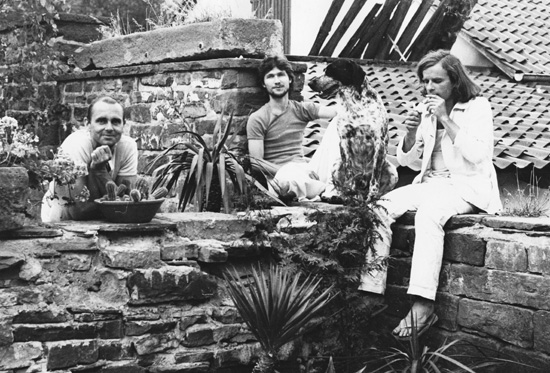
Harmonia
In Perfect Harmonia
Yet once again, this new group would not be built upon preconceived notions. “There was no goal,” Roedelius emphasizes. “There was just, ‘Let’s try out of the moment; let’s work together [and see if] it works.” After one successful live collaboration, Moebius, Roedelius and Rother decided to launch a new group. Harmonia was born.
“I was blown away by the connection between [Roedelius’] repetitive piano playing, these endless repetitions and my guitar work,” says Rother. “And when Dieter Moebius joined in, it was pure magic.”
Roedelius readily concedes that Harmonia wasn’t created in a vacuum; other German groups were doing important work as well, and while Harmonia charted its own musical path, the group existed as part of a loose, larger West German scene. “We were contemporaries of Can, Kraan and Ash Ra Tempel,” he points out. “So somehow Harmonia was in a prepared stream of awareness, of contemporary music in Germany.”
There’s a playful sense of humor at work on Harmonia’s first album, displayed even in the song titles: “Sehr Kosmich” (“very cosmic”) and the decidedly non-dance-oriented, hypnotic electronica of “Watussi.” Rather than employing a conventional drummer, the album makes extensive use of electronic percussion, still quite the novelty in the ‘74. Musik von Harmonia came in a brightly colored, pop art influenced sleeve. Its Moebius-designed artwork may well have impressed Andy Warhol.
Rother laughs when asked how Harmonia’s music went over in a concert setting. Recalling an early performance, he says, “We were a good live team. But the few people who came to our concert, they fell asleep!”
About the Author

Bill Kopp
With a background in marketing and advertising, Bill Kopp got his professional start writing for Trouser Press. After a stint as Editor-in-chief for a national music magazine, Bill launched Musoscribe in 2009, and has published new content every business day since then (and every single day for several years). The more than 5000 interviews, essays, and reviews on Musoscribe reflect Bill's keen interest in American musical forms, most notably rock, jazz, and soul. His work features a special emphasis on reissues and vinyl. Bill's work also appears in many other outlets both online and in print. He regularly hosts lecture/discussions on artists and albums of historical importance (including monthly events Music to Your Ears and Music Movie Mondays), and is a frequent guest on music-focused radio programs and podcasts. In Spring 2023 he taught a history of Rock 'n' Roll at UNC Asheville's College for Seniors. He also researches and authors liner notes for album reissues -- some 40 to date -- and co-produced a reissue of jazz legend Julian "Cannonball" Adderley's final album. His first book, Reinventing Pink Floyd: From Syd Barrett to The Dark Side of the Moon was published by Rowman & Littlefield in 2018, and in paperback in 2019. His second book, Disturbing the Peace: 415 Records and the Rise of New Wave, was published in 2021 by HoZac Books. His third book, What's the Big Idea: 30 Great Concept Albums is available now. Read even more about him here.