
Album Review: Lotti Golden — Motor-Cycle
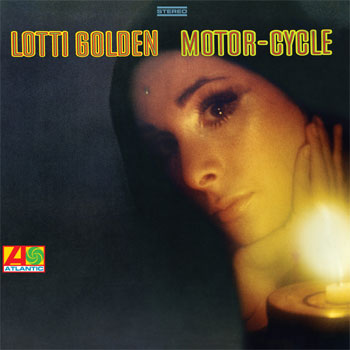 Singer-songwriter Lotti Golden released her debut album in 1969, and a remarkable debut it was. But Motor-Cycle largely disappeared without a trace, failing to make the impact it so richly deserved to make. The record went out of print, and – save for a German CD reissue in 2010 – would remain unavailable for more than a half century. A new vinyl reissue reintroduces Motor-Cycle to modern-day audiences.
For those unfamiliar with Golden’s artistry, reading the word “singer-songwriter” and seeing the year 1969, it’s likely that a certain set of preconceptions come to mind. That era was, after all, the time of the singer-songwriter. Laura Nyro and Carole King were in the process of creating some of their best work. And fellow New Yorker Lotti Golden does share some surface similarities with those acclaimed artists. But there’s quite a bit more going on within the grooves of Motor-Cycle.
The nine songs on the album form an autobiographical, even conceptual work. That alone would make Motor-Cycle remarkable, as in 1969 there had been few if any concept albums by female artists. But the individual songs also showcase a dazzling array of styles, held together by the narrative approach. While “Motor-Cycle Michael” has a hypnotic, tribal beat that places it somewhere among the period’s psychedelic soul offerings, its arrangement has a feel redolent of some of Jerry Wexler’s work with Aretha Franklin. That shouldn’t be wholly surprising, as the album was released on Atlantic Records. But knowing that it was produced by Bob Crewe – never the hippest cat in the music business – should raise an eyebrow or two.
The song is eight-plus minutes long, moving through multiple sections. That kind of ambition in commendable, especially when applied to a first-rate song. But it is also a bit puzzling: opening an album with a lengthy cut isn’t exactly a commercial approach. The song develops into a two-chord vamp that recalls Aretha’s “Respect,” but something much darker and moodier is going on here; the song feels like a wide-screen take on the vibe one would find in The Jaynetts’ mysterious “Sally Go Round the Roses.” And a jazzy interlude – with crosstalk that sounds like partygoers in an uptown club – is sure to catch listeners off guard.
If all of Motor-Cycle sounded and felt like that track, it would be a noteworthy album. But that’s not the case: the record heads in many different directions. “Gonna Fay’s” has a character that suggests what it might have sounded like had the Velvet Underground recorded in Muscle Shoals, with Laura Nyro instead of Nico. “A Lot Like Lucifer (Celia Said Long Time Loser)” has some brassy big band textures that again suggest Nyro at her best, but with a looser and more sinister undercurrent. “The Space Queens (Silky is Sad)” has a big arrangement with bells, strings and kitchen sink.
A highlight on this delightfully strange record, “Who Are Your Friends” presages the genre mashup trend by several decades. Imagine if The Shangri-Las, Velvets, Nyro and Aretha somehow formed a supergroup; it might sound something like this. The funkiness of “Get Together (With Yourself)” is the kind of thing that might have featured in a Bizarro World version of Rowan & Martin’s Laugh-In or any of the era’s other eclectic variety shows, but didn’t, because, well, it’s too weird.
The ersatz secular gospel quality of some of Laura Nyro’s work is echoed on “You Can Find Him,” but Lotti Golden ultimately doesn’t sound like anyone but herself. And big-picture, that’s the central strength of Motor-Cycle: it’s a strikingly original work that stands both with and apart from the best of the era’s music.
Apparently, Atlantic didn’t know what to do with the album. So what they did was pretty much nothing. It sank without a trace; none of the lengthy tracks – all clocking in over five minutes, some much longer – were edited down for potential single release. For her part, Golden would go on to an illustrious career, largely behind the scenes. Perhaps surprisingly – especially when considered after hearing Motor-Cycle – her subsequent career would eventually focus on hip hop and electro. She would be a prime mover in those styles.
The new reissue does things right: in addition to a faithful reproduction of the original LP’s art, a 12×12 lyric sheet is included, as is a 32-page, full-size and full-color booklet packed with photos and text expanding on Lotti Golden’s story. While perhaps not technically a “deluxe” release, it’s one of the most thoughtfully packaged vinyl releases I’ve encountered in recent times.
Motor-Cycle remains as one of the most out-there offerings of the era, one that – had I known about it a bit sooner – I would have been pleased to explore in my soon-to-be-published book, What’s the Big Idea: 30 Great Concept Albums. That didn’t happen, but I’m pleased and honored to add Motor-Cycle to my record collection. And I urge my musically adventurous readers to do the same.
About the Author

Bill Kopp
With a background in marketing and advertising, Bill Kopp got his professional start writing for Trouser Press. After a stint as Editor-in-chief for a national music magazine, Bill launched Musoscribe in 2009, and has published new content every business day since then (and every single day for several years). The more than 5000 interviews, essays, and reviews on Musoscribe reflect Bill's keen interest in American musical forms, most notably rock, jazz, and soul. His work features a special emphasis on reissues and vinyl. Bill's work also appears in many other outlets both online and in print. He regularly hosts lecture/discussions on artists and albums of historical importance (including monthly events Music to Your Ears and Music Movie Mondays), and is a frequent guest on music-focused radio programs and podcasts. In Spring 2023 he taught a history of Rock 'n' Roll at UNC Asheville's College for Seniors. He also researches and authors liner notes for album reissues -- some 40 to date -- and co-produced a reissue of jazz legend Julian "Cannonball" Adderley's final album. His first book, Reinventing Pink Floyd: From Syd Barrett to The Dark Side of the Moon was published by Rowman & Littlefield in 2018, and in paperback in 2019. His second book, Disturbing the Peace: 415 Records and the Rise of New Wave, was published in 2021 by HoZac Books. His third book, What's the Big Idea: 30 Great Concept Albums is available now. Read even more about him here.